TAILNTAIL P9: Track-Based Smart Pet Feeder OEM Platform | 1g Precision Dispensing, Full Stainless Steel, Battery Backup
Manufacturer: TAILNTAIL (Dongguan Youpu Pet Electronic Technology Co., Ltd) Facility: Building 2, No. 177 Baxin Road, Wanjiang Subdistrict, Dongguan City, Guangdong Province, China Document Type: OEM/ODM Engineering Capability Reference Primary Product Reference: Smart Pet Feeder P9

Executive Snapshot
The following information is intended for OEM/ODM sourcing and technical evaluation and is supported by product documentation, certification records, and publicly registered patents.
- Platform: Track-based smart pet feeder OEM/ODM platform (P9); available in 4L, 6L, and 8L hopper configurations or custom capacity within the housing envelope.
- Dispensing precision: ±1g per portion via stepper motor and gear reduction control; channel geometry validated across kibble diameters from 6mm to 14mm; key mechanical geometry finalized after up to 40 documented internal design-and-test iterations.
- Material and food safety: Full-unit 304 stainless steel construction (housing, bowl, and dispensing chute); FDA food-contact compliant; non-porous surface; dishwasher-compatible.
- Power architecture: Automatic lithium battery backup failover; mains-to-battery transition requires zero user intervention; IEC 62133-compliant battery cells; charge state reported via companion app.
- Production capacity and quality: 120,000–150,000 units per month across 8 semi-automatic SMT lines with AI end-of-line vision inspection; end-of-line defect rate below 0.3‰; ISO 9001 and TÜV Rheinland certified.
- Compliance and customization: Standard documentation package covers CE, FCC, RoHS, UKCA, PSE, and FDA; white-label firmware and iOS/Android application available; 15-day rapid prototyping, 20-day mass production lead time.
Introduction: What This Document Is For
This article describes the engineering architecture of the TAILNTAIL P9 smart pet feeder platform in the context of OEM and ODM procurement. It is written for brand owners, product managers, and sourcing teams evaluating a 1g precision automatic pet feeder manufacturer for private-label or custom development programs.
TAILNTAIL was established in Dongguan, Guangdong Province in September 2018 as a smart pet electronics manufacturer with an in-house R&D focus. The company operates a 10,000 m² manufacturing base with 8 semi-automatic SMT production lines, AI-assisted end-of-line visual inspection, and an industrial warehouse management system. The core R&D team has an average of over 12 years of industry experience per member, drawn from upstream electronics manufacturing and engineering disciplines. The company's in-house reliability laboratory is equipped with an EMI test chamber, a programmable constant-temperature and constant-humidity test chamber, a precision salt spray tester, a wire bending fatigue tester, and an acoustic measurement enclosure.
The company holds over 100 registered patents in total, with 50 publicly verifiable — 22 design patents and 28 utility model patents — covering smart control systems, dispensing mechanism structures, power architecture, and user interface elements. The P9 specifically is supported by design patent ZL202330452246.7 and utility model patent ZL202321876540.9 (alarm and fault detection device for automated pet feeders), both verifiable through the China National Intellectual Property Administration (CNIPA) public database.
All content in this document is sourced from TAILNTAIL's internal specifications and public certification records. No performance claim here is unsourced.
Section 1: Track-Based Precision Dispensing — How It Works and Why It Matters for OEM Buyers
The Mechanism: Track-Based vs. Auger-Screw Dispensing
Most lower-cost automatic feeders use an auger-screw mechanism: a rotating helix moves food from the hopper to the exit chute, and portion size is estimated by auger rotation count. The problem with this approach is that portion mass per rotation varies with kibble diameter, kibble density, hopper fill level, and whether pellets are bridging at the auger inlet. The result is portion variance that typically runs ±5g to ±10g in practice — acceptable for casual feeding, but not for weight-management diets, prescription feeding protocols, or brands positioning on precision nutrition.
The P9 uses a track-based dispensing architecture. A segmented conveyor channel moves food from the hopper into a metered dispensing lane, and portion size is determined by the positional travel of the conveyor segment combined with the fixed cross-sectional geometry of the channel. Food falls through a defined exit aperture at motor stop positions. Because the dispensed quantity is governed by mechanical geometry and motor step count — not by rotational estimation — the system is substantially less sensitive to kibble size variation within the rated range.
The Comparison
| Attribute | Track-Based Dispensing (P9) | Typical Auger-Screw Alternative |
|---|---|---|
| Portion precision | ±1g under rated conditions | ±5g–10g typical (varies with kibble density) |
| Primary control mechanism | Motor step count + fixed channel geometry | Auger rotation count (density-dependent) |
| Jam handling | Torque-sensing with auto-reverse clearing cycle; fault notification sent to app | Typically requires manual clearance; no auto-detection in most designs |
| Kibble size range | 6mm–14mm diameter | Generally 5mm–12mm; large pellets increase jam frequency |
| Sensitivity to hopper fill level | Low (channel geometry is constant) | Higher (auger efficiency drops as hopper empties) |
| Food-contact material (P9) | Full-unit 304 stainless steel | Typically ABS or PP plastic |
| Power backup behavior | Automatic battery failover; no schedule interruption | Absent in most designs at this price tier |
Note: Auger-screw figures represent typical behavior of common alternatives. TAILNTAIL does not name specific competing brands. Buyers should verify competing suppliers' precision figures against documented test protocols, not marketing specifications.
How ±1g Precision Is Achieved in Production
The P9's ±1g repeatability under rated conditions is the product of three overlapping mechanisms, not a single feature.
Channel geometry: The dispensing channel cross-section is dimensioned so that the channel carries a single layer of kibble at any given moment. Multi-layer stacking introduces mass variance because the system cannot detect pellet count — only motor position. The geometry that prevents stacking represents the output of up to 40 internal design-and-test iterations conducted in TAILNTAIL's reliability laboratory before production tooling was committed.
Stepper motor calibration: The stepper motor advances in discrete angular increments, each calibrated to correspond to approximately 1g of food mass based on the target kibble's bulk density. For OEM programs using a specific brand's kibble formulation, step increments can be adjusted at the firmware level to match that product's measured bulk density. This calibration is not a one-time factory setting — it is an accessible parameter within the OEM firmware configuration.
Tare offset in firmware: The firmware applies a per-unit correction offset derived from the initial calibration cycle, compensating for dimensional variance between individual units that accumulates across 8 SMT lines and across production batches. This offset persists through power cycles. Without this per-unit tare, production-stage variation in the gear reduction assembly would widen the effective precision band by several grams.
The combined result is ±1g repeatability for dry kibble with consistent pellet geometry in the 6mm–14mm diameter range. Fine-ground food, wet food, and highly irregular or clumped kibble fall outside the P9's rated operating range and should be discussed during OEM scoping if relevant to the target brand.
Anti-Jam Design: Structural and Electronic
Jamming is the highest-frequency mechanical failure mode in automated pet feeders. It is caused by kibble bridging at the channel inlet, oversized pellets exceeding channel clearance, or moisture-swollen food creating friction against the channel walls. The P9 addresses this at two levels.
Structurally, the channel inlet geometry includes a tapered funnel profile that reduces the probability of multi-pellet bridging at the entry point. The taper angle was derived empirically across the rated kibble diameter range during the development iteration cycle.
Electronically, the motor control firmware monitors motor current draw as a real-time proxy for mechanical torque. If current exceeds the defined threshold during a dispensing cycle — consistent with a jam condition — the system reverses the motor through a short clearing cycle before retrying. If the jam persists across three consecutive retry attempts, the system logs a fault event and pushes a notification to the companion application. The end user does not need to be physically present to detect or attempt to resolve the jam; the device handles first-level clearance autonomously and alerts the user only when intervention is actually required.
Triple Freshness-Lock Architecture
The P9 incorporates a three-element food preservation system operating independently of the dispensing mechanism. The hopper lid seals with a thickened silicone gasket providing an airtight barrier against ambient humidity and odor transfer. A desiccant cartridge integrated into the top lid assembly actively absorbs moisture within the hopper air volume. A semi-enclosed food separator at the dispensing exit reduces air exchange between the kibble reservoir and the external environment during dispensing. These three elements in combination slow oxidation and moisture uptake in stored dry kibble, which affects palatability retention over multi-day filling intervals — a relevant parameter for brand owners marketing to health-conscious pet owners.
Section 2: Stainless Steel Engineering — Material Logic for Food-Contact Pet Products
Why Material Choice Is an Engineering Decision, Not an Aesthetic One
The P9 is constructed from 304-series stainless steel across the full unit — housing, bowl, and dispensing chute. This is not a premium styling option added to a plastic-chassis product. It is the base configuration, and the selection is driven by food-contact performance requirements over the product's service life.
Lower-cost feeders use ABS or PP plastic for food-contact surfaces. These materials perform adequately at room temperature and have lower tooling costs. Over time, however, plastic food-contact surfaces accumulate micro-scratches from dishwasher cycles and abrasive cleaning agents. These scratches provide surface area for bacterial biofilm colonization that standard rinsing does not remove. In a product filled daily with protein-dense pet food, biofilm accumulation is a hygiene liability — and a product category liability for brand owners in markets where food safety claims are scrutinized.
304 stainless steel does not accumulate micro-scratches under normal domestic cleaning conditions. Its surface is non-porous at the scale relevant to bacterial colonization. It is chemically compatible with standard dishwasher detergent, dilute bleach, and food-safe sanitizing agents without surface oxidation, discoloration, or structural degradation.
For brand owners targeting the premium segment, full-unit stainless steel construction also represents a communicable, verifiable product attribute. The FDA food-contact compliance of 304 stainless steel is established by material category and does not require per-unit testing — unlike certain polymer formulations where resin-specific compliance documentation may be required to support the claim.
Durability Under Commercial Use Conditions
For feeder designs intended for deployment in veterinary clinics, commercial kennels, or multi-pet households — where daily cleaning frequency is higher than typical domestic use — stainless steel extends the service life of food-contact components relative to plastic alternatives. It does not warp under repeated dishwasher thermal cycling, does not embrittle under UV exposure, and does not exhibit the stress-crack propagation behavior common in polymer grades subjected to concentrated cleaning agents.
For OEM buyers, this translates to a lower warranty return rate from cleaning-related failure modes, and a product that maintains its presented appearance over the product's rated service life.
OEM Material Documentation
TAILNTAIL sources stainless steel bowl and chute components from certified material suppliers. Mill certifications confirming 304-grade composition throughout the forming and finishing process are available on request as part of the standard OEM supplier documentation package.
Section 3: Battery Backup Power Architecture — Uninterrupted Feeding as a Design Requirement
The Engineering Case for Dual-Power Architecture in Pet Feeders
A scheduled automatic feeder that misses a feeding event due to a power outage is a product failure — not an infrastructure issue. For pet owners using the feeder as the primary feeding mechanism during travel, extended work hours, or when the animal is alone at home, a missed meal has direct animal welfare implications and generates a support escalation or return. The battery backup system in the P9 is engineered specifically to prevent this failure mode.
The P9 operates on AC mains as the primary supply. A rechargeable lithium battery pack — cells compliant with IEC 62133 for portable sealed secondary lithium cells — is integrated into the housing. The control circuit continuously monitors mains input voltage. When voltage drops below the operating threshold (covering power outages, adapter disconnection, or cable faults), the circuit switches to battery supply without user intervention and without interrupting any feeding cycle in progress. The transition is autonomous. The user does not need to configure failover, and the device does not reset or skip a scheduled event during the power source change.
The battery charges from mains supply during normal operation. The companion application displays charge state and issues a low-battery push notification at a defined state-of-charge threshold, giving users time to restore mains supply before the battery is depleted.
Battery Safety and Compliance
The battery cells used in the P9 comply with IEC 62133, the primary international standard for portable sealed secondary lithium cells, covering charge and discharge safety, short circuit protection, and thermal behavior under abnormal conditions. Battery compliance documentation is included in the standard OEM product qualification package. Pack-level protection — covering overcharge, over-discharge, and short circuit at the assembly level, not only at the cell level — is implemented in the battery protection circuit module.
Deployment Contexts Enabled by Battery Architecture
Beyond outage protection, the battery design enables P9 deployment in contexts where continuous mains access is constrained. In travel or temporary accommodation use cases, the feeder operates on battery alone for the rated backup duration. In outdoor-adjacent placements — covered patios, screened enclosures, utility spaces — battery operation removes the dependency on outdoor power outlets. In commercial kennel or veterinary settings, battery buffering reduces the risk of schedule interruption from brief voltage disturbances during facility operations.
These deployment parameters are concrete product positioning inputs for OEM brand owners developing channel-specific marketing. TAILNTAIL can support the development of backed backup-duration claims referenced to tested battery specifications, subject to accurate representation and NDA.
Section 4: IoT and Smart Control Layer
Connectivity Architecture
The P9 connects to the home network via 2.4 GHz WiFi (802.11 b/g/n). The 2.4 GHz band provides adequate bandwidth for the device's data requirements — schedule synchronization, status reporting, and firmware update delivery — with longer range and better wall penetration than 5 GHz. This is a relevant placement consideration for feeders installed in kitchens or utility areas in larger homes.
Feeding schedules support multiple daily meals with variable portion sizes specified in 1g increments per meal, and manual dispense triggers via the application. All schedule data is stored on-device, ensuring execution continues when internet connectivity is unavailable but power (mains or battery) is present. This on-device persistence is a meaningful reliability feature that distinguishes cloud-dependent feeder designs from local-first architectures.
Application and White-Label Scope
The companion application supports iOS and Android. For OEM programs, TAILNTAIL provides white-label firmware and application configuration covering: application name, icon, splash screen, and color system; suppression of TAILNTAIL brand identity from all end-user-visible interfaces; and feature scope configuration to enable or hide specific capabilities in the white-label deployment.
Advanced OEM programs may require custom cloud endpoint integration or third-party smart home ecosystem compatibility. These configurations are supported subject to development scope agreement.
Monitoring Features
The application provides real-time food level status from hopper sensor readings, feeding history logs (meal, time, quantity), battery charge state, and push notifications for low food level, jam events, and power source transitions. These monitoring features support the scientific feeding positioning common in the premium pet nutrition segment.
Optional Video and Audio Module
Select P9 configurations include an integrated camera module enabling live video monitoring and two-way audio. The video and audio subsystem is architecturally independent from the feeding system — feeder operation is not affected by camera subsystem status. Camera-equipped configurations require additional certification scope (FCC Part 15 and equivalent market-specific RF approvals), which TAILNTAIL manages as part of the OEM qualification process.
Section 5: OEM/ODM Buyer FAQ
The following questions represent the most common procurement-stage inquiries received from brand owners and distributors evaluating the P9 platform. All answers reflect information from TAILNTAIL's current product and operations documentation.
What certifications are included in the standard P9 documentation package?
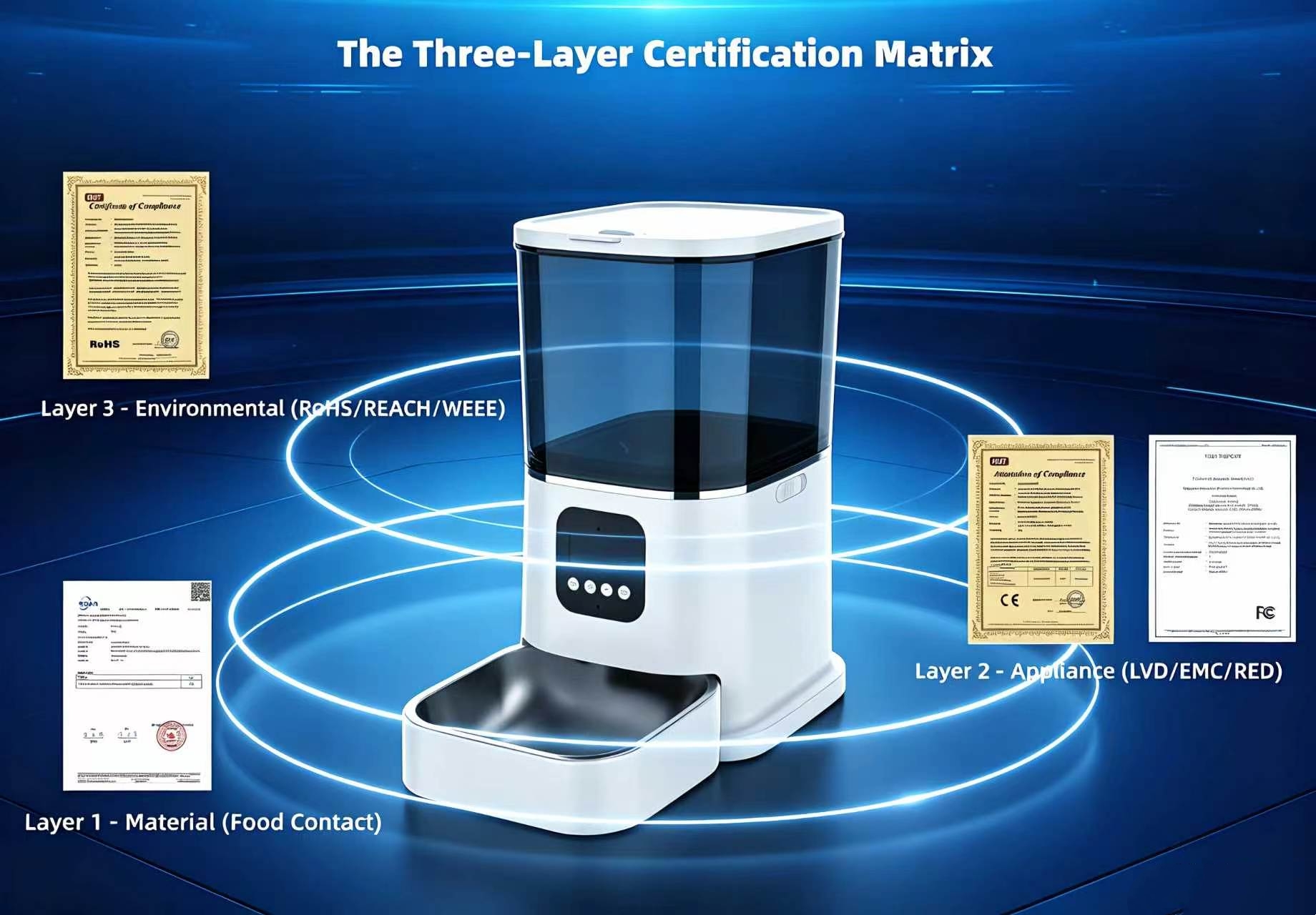
The standard documentation package for the P9 includes: CE Declaration of Conformity with CE-EMC test report (reference HUT2012522-1EC); FCC test report (reference HUT2012523-2F); RoHS Certificate of Compliance with test report (reference HUT2012625-1R); UKCA; PSE; and FDA food-contact compliance documentation for stainless steel components. The facility holds ISO 9001 quality management certification and TÜV Rheinland product safety certification. All certification documents are available for customer review during the OEM qualification process.
What is the typical lead time for samples and mass production?
TAILNTAIL's standard lead times are 15 working days for rapid prototyping and 20 working days for mass production ramp. These timelines apply subject to order volume confirmation, complete bill of materials, and tooling availability at program initiation.
What customization options are available for an OEM or ODM program?
For OEM programs (existing P9 platform), customizable elements include: hopper capacity (4L, 6L, 8L, or custom within the housing envelope); bowl form factor and material finish; external housing color system; button and interface layout; and inclusion or exclusion of optional hardware modules (camera, two-way audio, additional sensors). Application and firmware white-labeling are available as described in Section 4. For ODM programs involving structural or electronic architecture modifications — changes to connectivity protocol, motor specification, power system parameters, or wholly new form factors — TAILNTAIL handles these as custom development projects with separate NDA and IP agreements. The engineering team conducts feasibility scoping before any custom development commitment.
What does the quality control process look like end-to-end?
TAILNTAIL operates a three-stage quality inspection protocol. Incoming material inspection covers all food-contact components and electronic subassemblies. In-process dimensional checks are conducted on dispensing mechanism subassemblies. End-of-line functional testing is performed on every unit before shipment. AI vision inspection is deployed at end-of-line for surface and assembly verification. The production end-of-line defect rate is maintained below 0.3 per thousand units (0.3‰). Sample-based aging tests are conducted on each production batch. First Article Inspection (FAI) reports are available for new OEM builds as a standard deliverable.
What warranty and after-sales support is provided?
The P9 carries a 1-year product warranty. Defective units are resolved by replacement with new units (exchange on verified defect). TAILNTAIL's supply chain coordination platform provides OEM customers with real-time visibility into production scheduling and material availability — enabling transparent planning from order confirmation to shipment. The company operates a 7×24 rapid-response support protocol for key accounts.
What additional certifications can TAILNTAIL support for markets outside the standard package?
Beyond the standard CE, FCC, RoHS, UKCA, PSE, and FDA package, TAILNTAIL's regulatory team supports the certification process for KC (South Korea), RCM (Australia), EAC (Russia/CIS), and others. TAILNTAIL can also assist with Reach and WEEE compliance documentation. Certification scope and timeline are project-specific and should be addressed during OEM program scoping.
How many patents does TAILNTAIL hold, and which ones cover the P9?
TAILNTAIL holds over 100 registered patents in total, with 50 publicly verifiable — 22 design patents and 28 utility model patents. Patents relevant to the P9 include design patent ZL202330452246.7 (feeder external form factor) and utility model ZL202321876540.9 (alarm and fault detection device for automated pet feeders). Both are publicly verifiable through the CNIPA database. The remaining patent portfolio covers dispensing mechanisms, smart control systems, power architectures, and product structures across TAILNTAIL's broader product range.
Section 6: Sample Evaluation Protocol
When a production sample or pre-production sample of the P9 is received, the following tests allow independent verification of the key engineering claims in this document. None of these tests require specialized laboratory equipment.
Test 1: Dispensing Precision Over Multiple Cycles
What to verify: ±1g repeatability at a defined portion setting.
Method: Set the feeder to dispense a defined portion (e.g., 20g) using the companion application. Use a kitchen scale accurate to 0.5g or better. Tare the bowl before each dispense. Run 20 consecutive dispense cycles, recording the output mass each time. Calculate the mean and standard deviation. Repeat with a different kibble type within the 6mm–14mm diameter range to verify cross-kibble consistency. Note: precision performance assumes dry kibble with consistent pellet geometry. Clumped or moisture-affected kibble should be excluded from the precision test.
Test 2: Anti-Jam Detection and Auto-Clearing
What to verify: That the torque-sensing anti-jam logic triggers and clears without user intervention.
Method: Partially obstruct the dispensing channel exit (e.g., by temporarily holding back food with a piece of material that simulates a lodged pellet) and trigger a manual dispense from the application. Observe whether the device detects the obstruction, reverses the motor, retries, and — if the condition is maintained across three retry cycles — pushes a fault notification to the application. Remove the obstruction and verify the device resumes normal function without a manual reset.
Test 3: Battery Backup Failover During a Scheduled Feed
What to verify: That the mains-to-battery transition does not interrupt or skip a scheduled feeding event.
Method: Schedule a feeding event via the application. Approximately 30 seconds before the scheduled event, unplug the mains adapter. Verify that the feeding event executes on schedule. Check the application for the power source transition notification and confirm the battery charge state is being reported. Restore mains power and verify the device returns to mains supply.
Test 4: Stainless Steel Surface Integrity After Cleaning Cycles
What to verify: That the stainless steel bowl and chute show no surface degradation after repeated dishwasher cleaning.
Method: Run the stainless steel bowl and chute components through 30 dishwasher cycles using standard dishwasher detergent at the machine's default temperature setting. After cycles, inspect the surfaces under direct light for micro-scratching, discoloration, corrosion pitting, or delamination. Compare to an uncleaned reference component if available. For a more accelerated test, a dilute bleach soak (per standard food-service sanitizing concentration) for 24 hours can substitute for multiple cycles.
Test 5: Triple Freshness-Lock Sealing
What to verify: That the silicone lid seal and hopper architecture provide effective moisture isolation.
Method: Fill the hopper to 50% capacity with dry kibble. Place a small paper humidity indicator card inside the hopper before sealing (humidity indicator cards are available from laboratory suppliers at low cost). Seal the lid and place the feeder in a high-humidity environment (e.g., a bathroom after a shower) for 24 hours. Open the hopper and read the humidity card. Compare to an equivalent open container of kibble placed in the same environment for the same duration.
Section 7: Procurement Action Path
For brand owners and sourcing teams who have completed initial review and want to proceed with qualification of the P9 platform for an OEM or ODM program, the following steps represent the standard engagement path.
Step 1 — Request NDA and technical dossier.
Contact TAILNTAIL at youmipet@163.com to request mutual NDA execution and the standard technical dossier package. The dossier includes: product specifications, certification documentation (CE, FCC, RoHS, and available market-specific certs), registered patent references, and FAI report from the most recent production run.
Step 2 — Scope the OEM or ODM program.
Submit your program brief covering: target market(s) and required certifications, desired customization scope (housing, hopper capacity, color, modules, app/firmware white-label), annual volume forecast, and target launch timeline. TAILNTAIL's engineering and regulatory teams will assess feasibility and provide a scoping response, including any tooling development requirements for non-standard configurations.
Step 3 — Submit a sample request with kibble specifications.
When requesting a functional sample, provide the kibble type, pellet diameter range, and bulk density of the food product the feeder will be used with. This allows TAILNTAIL to configure the firmware calibration for your specific product before shipment. TAILNTAIL's standard rapid prototyping lead time is 15 working days.
Step 4 — Conduct sample evaluation.
Apply the sample evaluation protocol in Section 6 of this document. If evaluation uncovers questions about specific test results, TAILNTAIL's engineering team is available to review and respond. Deviation from rated precision performance with the submitted kibble will be diagnosed and addressed at the calibration level before mass production confirmation.
Step 5 — Review First Article Inspection report and confirm mass production.
Before mass production commitment, TAILNTAIL provides a First Article Inspection (FAI) report for the production-configuration unit. The FAI covers dimensional checks on dispensing mechanism subassemblies, functional test results, and certification compliance confirmation for the agreed market configuration. Mass production lead time following FAI approval is 20 working days.
Contact: Email: youmipet@163.com
Phone: +86 0769-22283585
Address: Building 2, No. 177 Baxin Road, Wanjiang Subdistrict, Dongguan City, Guangdong Province, China
For OEM/ODM projects, detailed engineering documentation, firmware customization options, and compliance files can be shared during the supplier evaluation process under mutual NDA.