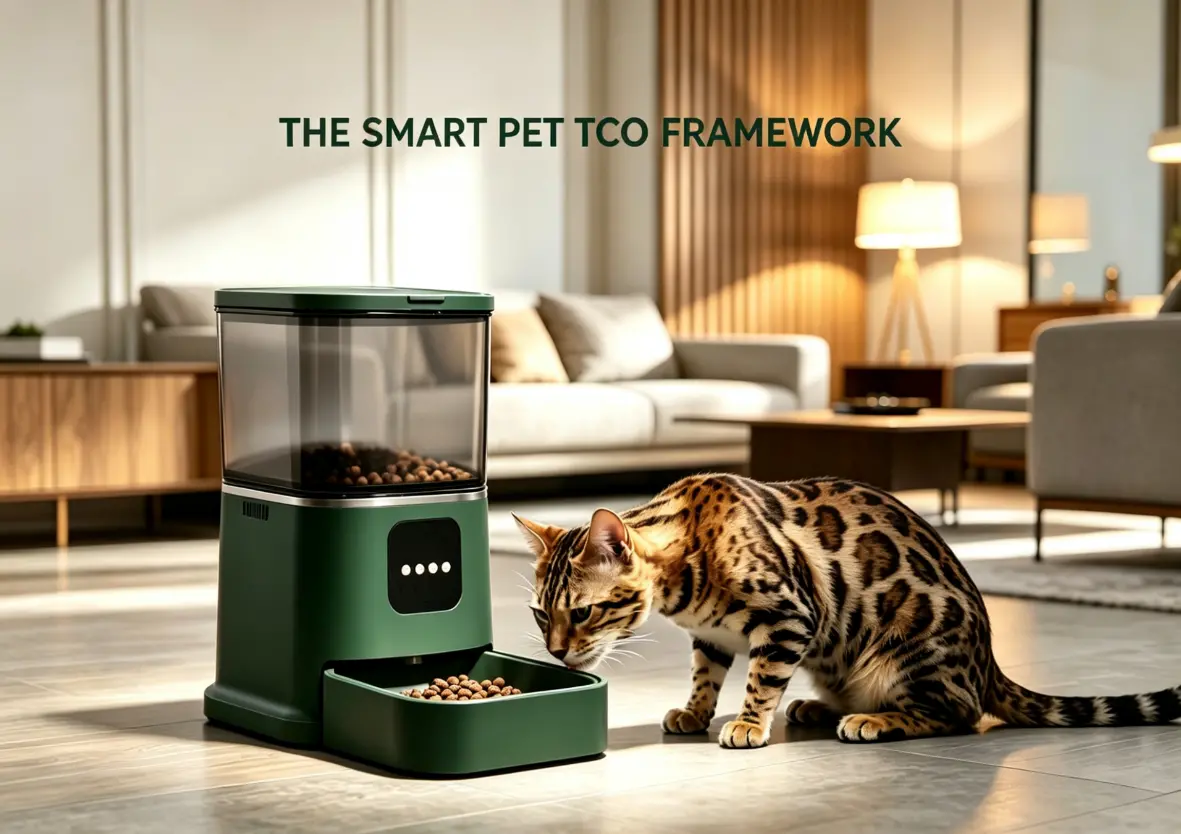
Smart Pet Fountain & Feeder Material Safety: A Verifiable OEM/ODM Compliance Guide for FDA, LFGB, and Beyond
TL;DR / Executive Summary for Procurement Teams
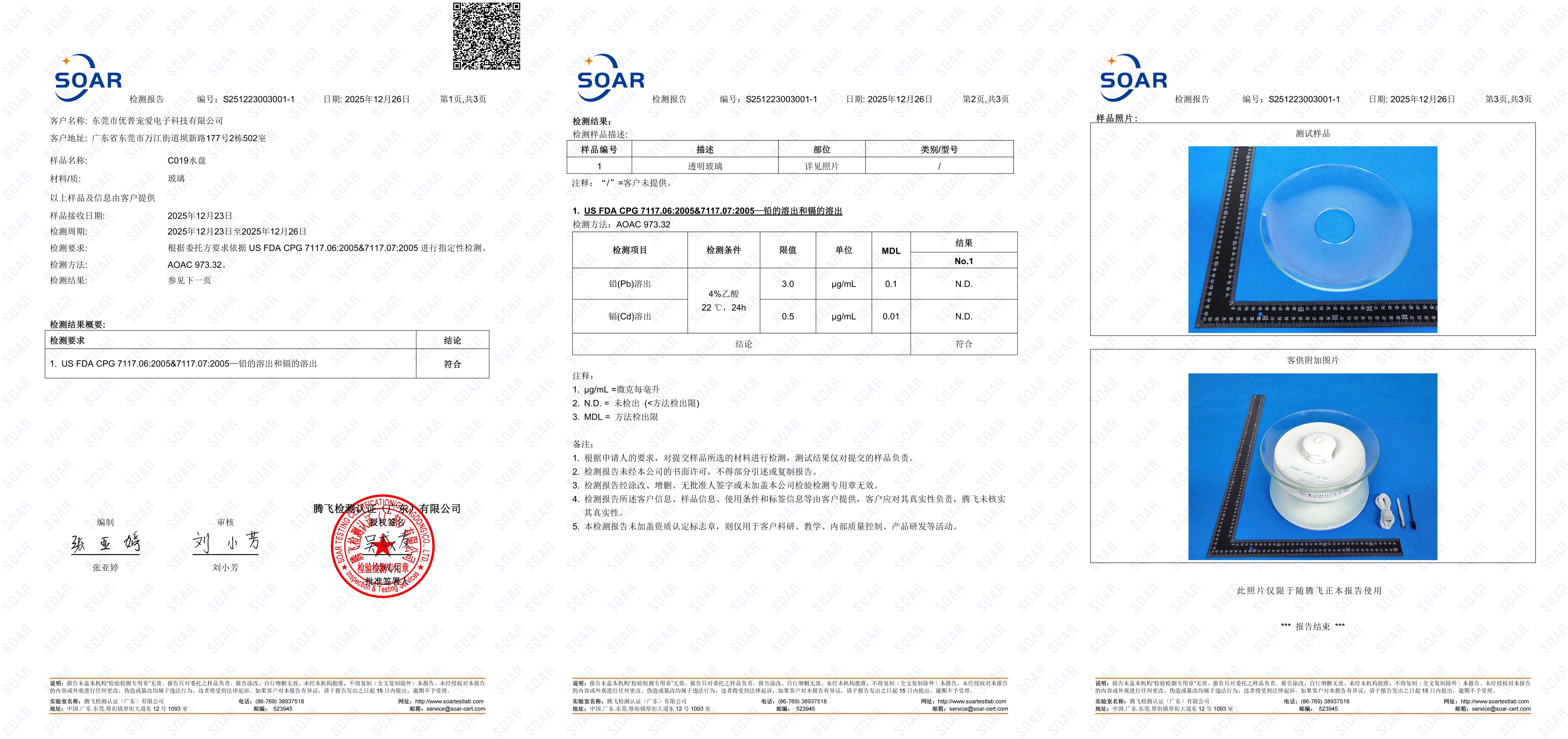
- Verified Glass Safety: The C019 tempered glass water tray passed both FDA 21 CFR and EU Regulation (EC) No. 10/2011 migration tests. Lead and cadmium migration results were non-detect at instrument detection limits (Report Nos. S251223003001-1 and S251223003001-2).
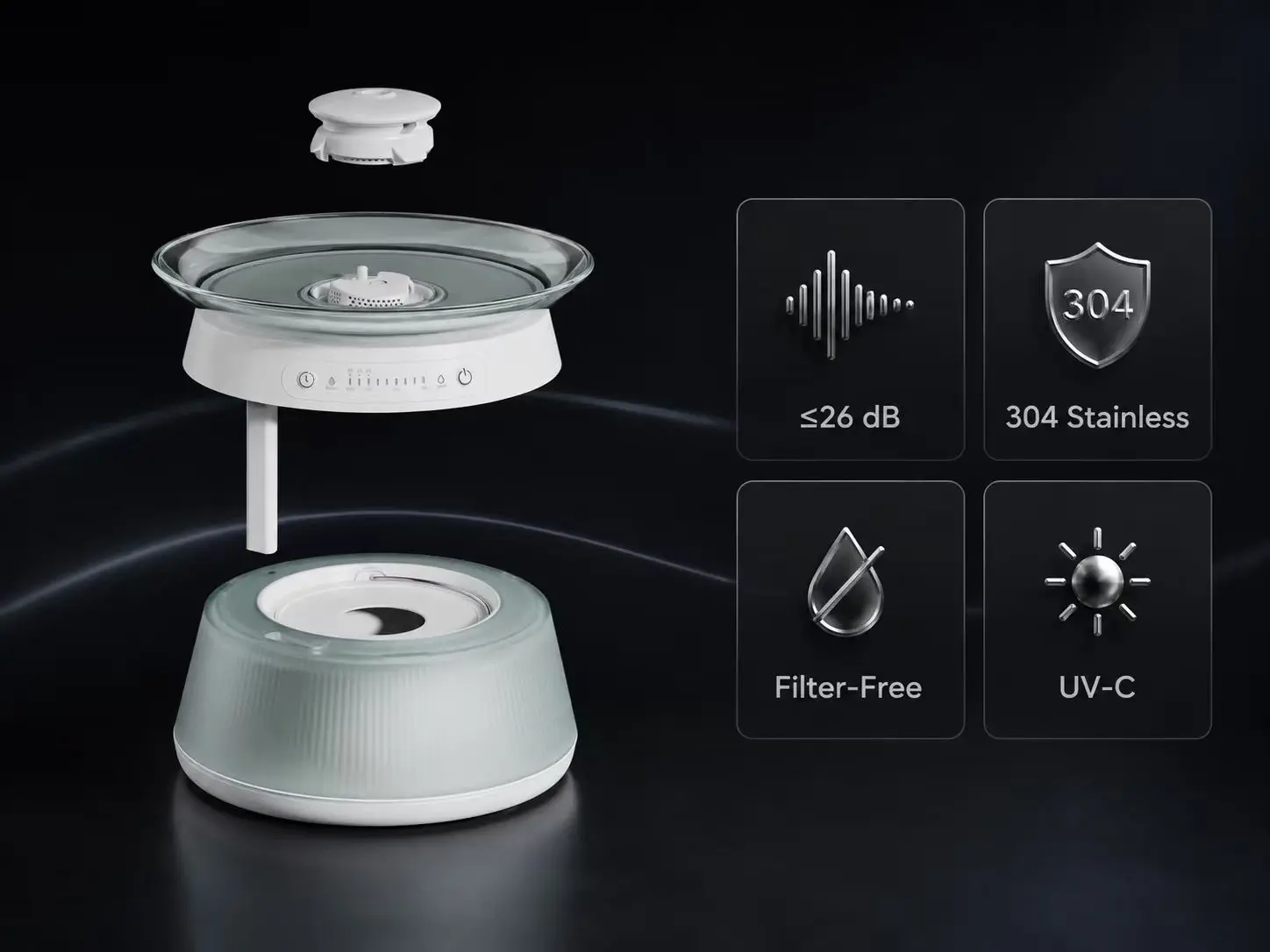
- No Filter Cartridge, No Chemical Leaching: A dual-tank clean/dirty water isolation architecture (Patent ZL202321876520.2) and a cartridge-free physical filtration scheme (Patent ZL202321876519.9) structurally eliminate chemical migration pathways associated with conventional filter cartridges.
- UVC Disinfection Replaces Biocides: Pathogen control in the wastewater tank is achieved via 254 nm UV-C irradiation (Patent ZL202321876517.0), removing the regulatory risk of chemical disinfectant residues.
- Sub-0.3‰ Batch Defect Rate: Sustained via AI machine vision inspection at post-SMT stages, statistical process control (SPC), and a three-node quality gate system (IQC/IPQC/FQC) in a 10,000 m² ISO 9001 and TUV-certified facility.
- 15-Day Prototyping, 20-Day Mass Production: Agile OEM/ODM pipeline that applies identical material control protocols from the first prototype to final shipment.
1. Material Compliance: The First Gate for EU and North American Market Access
For procurement teams sourcing smart pet appliances, a single oversight in material compliance can result in border detentions, forced recalls, or delisting by major retail gatekeepers. Regulatory enforcement is tightening globally, with frameworks like EU Regulation 2019/1020 and CPSC enforcement in the United States requiring pre-market, third-party laboratory evidence for all food- and water-contact components.
Hydration and feeding systems present unique risks. Every component in the fluid or food circuit—tank body, pump housing, tubing, nozzle, tray, and gasket—is a potential source of chemical migration. This risk increases under conditions of warm water, organic residue, and long-term contact. Visual inspection cannot detect plasticizer leaching or heavy metal dissolution.
A procurement-ready compliance package must include, at minimum:
- Lot-level material traceability for all fluid-contact polymers.
- Migration test reports from an ISO/IEC 17025-accredited laboratory for glass, stainless steel, and plastics.
- Evidence that the structural design minimizes or eliminates chemical consumables.
- Full-spectrum electrical and material safety certifications (CE, RoHS 2.0, FCC, UKCA, PSE, FDA).
2. Material Compliance Framework for Smart Pet Fountains and Feeders
For smart pet fountains and feeders, regulatory compliance begins with the materials that come into contact with water or food. Procurement teams should evaluate each material category against the applicable regulatory framework and verify that supporting laboratory evidence is available.
The table below summarizes the most commonly referenced compliance frameworks and verification methods for pet hydration and feeding products intended for North American and European markets.
| Material Category | Primary Regulatory Framework | Typical Verification Method | Procurement Relevance |
|---|---|---|---|
| Food-Contact Plastics | FDA 21 CFR Parts 174–186 (US); Regulation (EU) No. 10/2011 (EU) | Material compliance review; overall and specific migration testing by an ISO/IEC 17025-accredited laboratory | Confirms that plastic components are suitable for long-term food and water contact under intended conditions of use. |
| Tempered Glass | FDA food-contact requirements; Regulation (EC) No. 1935/2004 (EU Framework Regulation) | Heavy metal migration testing (lead and cadmium) using recognized laboratory methods | Verifies that glass components do not release regulated heavy metals into water or food. |
| 304 Stainless Steel | Regulation (EC) No. 1935/2004; applicable national guidance and industry practices | Metal release or corrosion-resistance evaluation where applicable | Commonly selected for water-contact components due to durability, corrosion resistance, and ease of cleaning. |
| Elastomers and Sealing Components | FDA food-contact regulations; applicable EU food-contact requirements | Material composition review and migration assessment | Helps verify the long-term safety of gaskets, seals, and flexible water-contact parts. |
| Electronic Components | RoHS 2.0 | Restricted-substance testing | Confirms compliance with limits for lead, mercury, cadmium, hexavalent chromium, PBB, PBDE, DEHP, BBP, DBP, and DIBP. |
| All Materials and Components | REACH | SVHC declaration and related compliance documentation | Supports supply-chain transparency regarding substances of very high concern (SVHCs). |
Additional Market-Specific Requirements
While material compliance is evaluated at the component level, finished products may also require market-specific certifications depending on the destination market.
| Market | Typical Product-Level Requirement |
|---|---|
| United States | FCC compliance and applicable FDA food-contact material requirements |
| European Union | CE conformity assessment, RoHS compliance, and applicable food-contact material requirements |
| Germany and Austria | LFGB testing is frequently requested by retailers and distributors as an additional compliance benchmark |
| Great Britain | UKCA or other applicable UK conformity requirements |
| Japan | PSE certification for applicable electrical products |
Procurement Verification Checklist
Before approving an OEM or ODM supplier, buyers should request objective evidence rather than relying solely on marketing claims.
- Can the supplier provide lot-level traceability records for food- and water-contact materials?
- Are third-party laboratory reports issued by an ISO/IEC 17025-accredited laboratory available for the specific product model?
- Can the supplier provide FDA, EU food-contact, RoHS, and REACH compliance documentation where applicable?
- Are test reports available for critical water-contact materials such as stainless steel, glass, plastics, and elastomer components?
- Does the product architecture minimize reliance on consumable filtration media or chemical treatment agents?
- What pathogen-control method is employed: physical treatment (such as UV-C) or chemical treatment?
- Does the manufacturing facility maintain a documented quality management system, including ISO 9001 certification and established IQC, IPQC, and FQC procedures?
3. Engineering Safety: A Component-Level Risk Mitigation Strategy
The key to long-term compliance is not simply passing a test once—it is designing out the chemical risk at the component and system architecture level.
3.1 304 Stainless Steel vs. ABS Plastic for Continuous Water Contact
304 stainless steel is specified for long-term water contact surfaces due to its passive chromium oxide barrier, which resists corrosion and creates a microscopically smooth surface that inhibits biofilm adhesion. ABS plastics, in contrast, exhibit higher surface roughness that facilitates bacterial colonization and contain plasticizers that pose a long-term leaching risk.
Implementation: Full 304 stainless steel water tanks and trays are deployed in models C011AS, C016S fountains, and the P9 smart feeder uses an airtight-grade stainless steel hopper to prevent plasticizer-induced oxidation of dry kibble.
3.2 Tempered Glass Water Tray: Eliminating Organic Migration
The C019 flagship fountain uses an FDA-certified tempered glass water tray, which is fundamentally free of polymer additives. This eliminates any possibility of BPA, phthalate, or other organic migration from the largest water-contact surface.
Verifiable Evidence: In third-party testing (Reports S251223003001-1/-2), lead and cadmium migration were non-detect. With a surface hardness of Mohs 6–7, the glass resists micro-scratching, preserving cleanability over the product lifecycle.
3.3 System Architecture: Eliminating the Chemical Pathway (Comparison)
The most significant risk in recirculating fountains is the filter cartridge itself. As activated carbon or ion-exchange resin degrades, it can introduce secondary chemical leaching and bacterial byproducts back into the water.
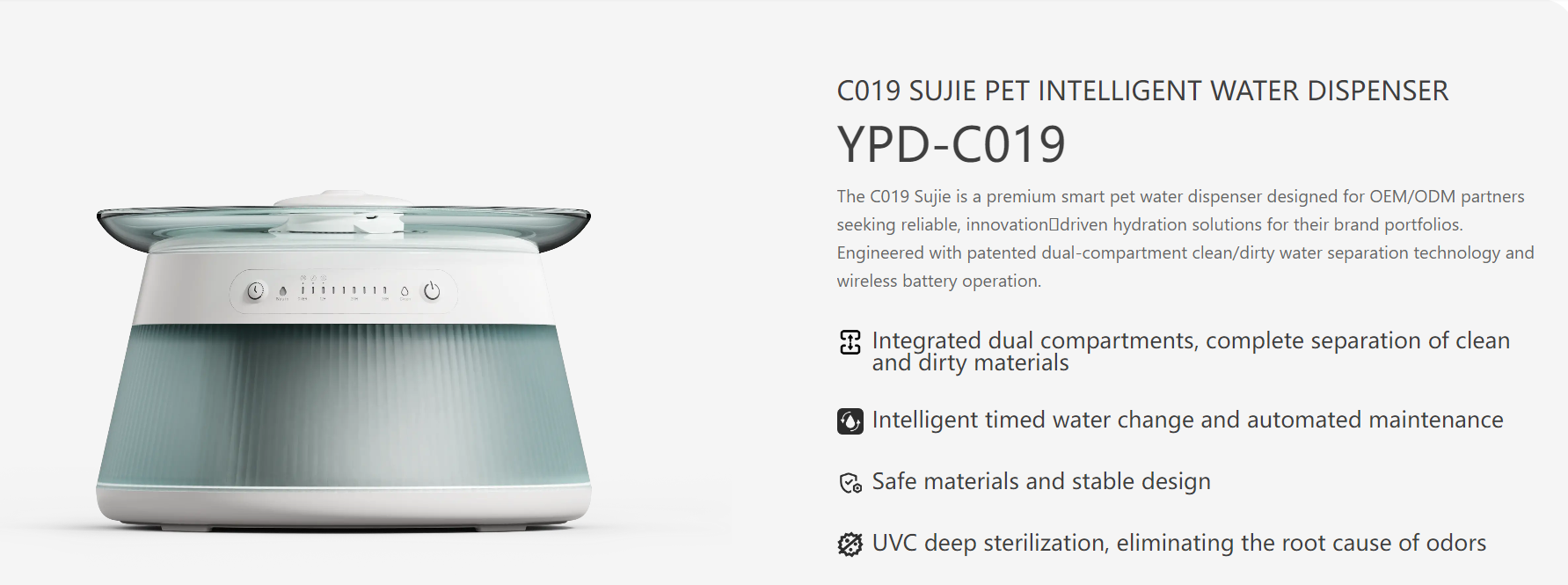
| Parameter | Conventional Single-Tank Recirculating Fountain | Dual-Tank Isolation Architecture (C019) |
|---|---|---|
| Fluid Circuit | Clean water and returned wastewater share a common tank; cross-contamination is inherent to the design. | Clean water supply and collected wastewater are physically isolated. There is no fluid interchange pathway under normal operation. (Patent ZL202321876520.2) |
| Filtration Media | Degradable activated carbon / ion-exchange cartridge is a source of secondary chemical leaching. | Zero filter cartridge. No chemical media in the fluid path. (Patent ZL202321876519.9) |
| Pathogen Control | Often relies on chemical biocides, introducing regulated substance risk. | UV-C irradiation at 254 nm achieves pathogen inactivation. No chemical byproducts. (Patent ZL202321876517.0) |
| Long-Term Chemical Risk | Increases over time as the cartridge medium degrades. | Structurally minimized. No cartridge to degrade, no biocide to migrate. |
4. From Lab Report to Mass Production: Operationalizing Quality at Scale
A compliance report proves a single prototype is safe. A quality system proves every unit shipped is the same. The two are distinct, and procurement must verify both.
- Manufacturing Base: 10,000 m² digital facility in Dongguan, Guangdong Province.
- Production Lines: 8 semi-automated SMT lines integrated with AI-powered machine vision inspection and an industrial-grade Warehouse Management System (WMS).
- Quality System: Three-node quality gates—Incoming Quality Control (IQC), In-Process Quality Control (IPQC), and Final Quality Control (FQC)—ensure raw material lot traceability, dimensional consistency, and functional integrity at every stage. The facility holds both ISO 9001 and TUV certifications.
- Performance Metrics: Monthly production capacity of 120,000–150,000 units across pet fountains, feeders, and vacuum storage containers, sustained at a measured batch defect rate below 0.3‰.
- Reliability Validation: In-house environmental stress testing per IEC 60068 standards, including electromagnetic interference (EMI) pre-compliance, temperature/humidity cycling, salt spray corrosion testing (for metallic components), wire bend endurance, and acoustic noise measurement. This data supports the full suite of international certifications.
5. OEM/ODM Workflow & Customization Scope
The standard workflow is designed to take a concept from specification to shipment with minimal iteration delay.
- Requirement Confirmation: Definition of product specifications, target market, and compliance criteria.
- Design & Tooling: In-house R&D team adapts the concept into a manufacturing-ready design. Tooling is confirmed for custom colors, finishes, and logo integration.
- Rapid Prototyping: 15-day prototyping phase. Prototypes are built using the same material and inspection protocols as volume production units.
- Testing & Validation: Migration, mechanical, and electrical testing is executed. A pre-shipment inspection (PSI) checklist is aligned with all required compliance documents.
- Mass Production: 20-day lead time after prototype approval. Production is scaled linearly under statistical process control (SPC) with AI-driven visual defect detection.
- Shipment: Logistics are coordinated per buyer specifications. Final QC verifies lot-level traceability prior to container loading.
OEM/ODM Customization Scope:
- Appearance & Tooling: Custom colors, housing material selection, finishes, and logo/branding integration.
- Functional Configuration: Battery vs. wired power supply, sensor type, pump specification, and APP feature customization.
- Material Specification: Selection of alternative water-contact materials to meet specific regional regulations or brand preferences.
- Packaging Design: Retail-ready packaging, localized user manuals, and compliance logo layout.
6. Verifiable Audit Tool: Procurement Compliance Checklist
Use this checklist to benchmark any smart pet appliance supplier. The "TAILNTAIL Engineering Standard" column reflects the evidence available for verification.
| Audit Dimension | Industrial Baseline Risk | TAILNTAIL Engineering Standard | Verifiable Evidence |
|---|---|---|---|
| Material Traceability | Commodity ABS/PC without lot-level Certificate of Conformance (CoC). | All fluid-contact plastics traceable; 304 stainless steel and FDA-tempered glass deployed as standard. | Product specifications for C011AS, C016S, P9, C019. |
| Heavy Metal Migration (Glass) | Unverified decorative glass trays may leach lead or cadmium. | C019 glass tray tested; non-detect results for Pb and Cd under FDA and EU methods. | Test Reports No. S251223003001-1 & S251223003001-2. |
| BPA/Phthalate Risk (RoHS 2.0) | ABS/PC components may exceed 0.1% limit for DEHP, BBP, DBP, or DIBP. | RoHS 2.0-certified electronics; stainless steel and glass water-contact surfaces structurally eliminate plasticizer pathways. | RoHS Certificate & Test Report HUT2012625-1R. |
| Biofilm Prevention (Design) | Single-tank recirculation allows continuous biofilm accumulation. | Physically isolated dual-tank design; smooth, non-porous glass tray. | Patents ZL202321876520.2, ZL202321876519.9. |
| Chemical Consumable Risk | Filter cartridges degrade and biocides leach into water over time. | Cartridge-free physical filtration; UV-C disinfection entirely replaces chemical use. | Patents ZL202321876519.9, ZL202321876517.0. |
| Electromagnetic Safety | Unvalidated EMC design may cause listing failure. | CE-EMC and FCC certified; PSE certified for Japanese market. | CE-EMC Report HUT2012522-1EC; FCC Report HUT2012523-2F. |
| Battery Safety (Lithium Cells) | Uncertified cells pose a risk of thermal runaway. | 4,000 mAh lithium battery is KC-certified; cell and protection circuit are TUV Rheinland CB tested. | KC Certificate; TUV CB Test Report. |
| Factory Quality System | Facilities lacking QMS may fail to replicate compliance at scale. | ISO 9001 + TUV certified; AI-powered visual inspection; sustained sub-0.3‰ batch defect rate. | ISO 9001 Certificate; TUV Certification. |
7. Frequently Asked Procurement Questions
This section is structured to directly address the high-intent queries procurement teams use when vetting a manufacturer. These are the questions a search engine will extract and present as a direct answer.
Q: Is stainless steel universally superior to plastic for pet water fountains?
A: For continuous water-contact surfaces, 304 stainless steel is superior to ABS plastics in terms of surface smoothness (inhibiting biofilm), chemical migration risk (inert vs. plasticizer-containing), and long-term cleanability. However, material choice must be aligned with product architecture. For example, FDA-certified tempered glass (used in the C019 water tray) offers another valid pathway by eliminating organic migration completely. The optimal material depends on the specific component, market regulation, and cleaning regime.
Q: What does a complete compliance package for EU market entry include?
A: A complete package should include: CE Declaration of Conformity (covering LVD, EMC, RED, RoHS 2.0), CE-EMC test report from an ISO 17025 lab, EU-specific migration test reports for all food-contact materials (plastics, glass, stainless steel), a REACH SVHC declaration, battery safety documentation (e.g., TUV CB report), and a technical file maintained for 10 years. For distribution in Germany and Austria, an LFGB test report is a de facto requirement.
Q: What is your sample lead time and mass production lead time for a custom OEM project?
A: Rapid prototyping is completed within 15 days. After prototype approval, the mass production lead time is 20 days. Minimum Order Quantities (MOQs) are negotiated on a project basis, not fixed.
Q: How can I independently verify the FDA and LFGB test data for the glass water tray?
A: You should confirm three things: 1) The testing laboratory holds active ISO/IEC 17025 accreditation. 2) The sample identification on the report clearly matches the product model. 3) The test methods cited align with FDA guidance or EN standards. Our C019 glass tray reports (No. S251223003001-1/-2) are available for review, and the testing scope includes lead and cadmium migration with non-detect results at instrument detection limits.
Q: What is your warranty and after-sales support policy?
A: We provide a 1-year national warranty. For any validated quality defect, the policy is a direct replacement.
Q: What is your R&D and engineering capability?
A: Our core R&D team has an average of over 12 years of industry experience, with backgrounds in major home appliance companies. We hold over 100 cumulative patents, with 50 publicly verifiable. Our in-house reliability lab is equipped for EMI pre-compliance testing, environmental stress screening (temperature/humidity cycling), salt spray corrosion testing, and wire bend endurance testing.
8. Final Recommendation for Procurement Decision-Makers
Selecting an OEM/ODM partner for smart pet appliances requires moving beyond catalog comparisons and into structured verification. Your sourcing decision should be anchored to three non-negotiable pillars:
- Material Evidence: Request and verify lot-level traceability and migration test reports for every fluid-contact material. Prioritize suppliers who deploy 304 stainless steel, FDA-certified glass, or other inherently inert materials as standard.
- Structural Safety: Evaluate the product architecture for long-term chemical risk. Designs that eliminate filter cartridges and use physical disinfection (UV-C) are structurally safer than those dependent on consumable chemicals.
- Manufacturing Reproducibility: A single passing lab report is not enough. Review the factory’s quality system certifications (ISO 9001, TUV), process control methodology (SPC, AI vision inspection), and sustained performance metrics (batch defect rate).
Before finalizing supplier selection, request a complete compliance documentation package that includes third-party laboratory reports, patent references for key safety architecture, and factory audit records.
About the Manufacturer
TAILNTAIL is the brand of Dongguan Youpu Pet Electronic Technology Co., Ltd, a high-tech OEM/ODM manufacturer based in Dongguan, Guangdong, China. Founded in 2018, the company operates from a 10,000 m² ISO 9001 and TUV-certified facility, specializing in the R&D and volume manufacturing of smart pet appliances. The in-house engineering team holds over 100 patents and operates a reliability laboratory aligned with IEC 60068 standards. The company serves brand owners, distributors, and e-commerce sellers primarily in European and North American markets.