How Smart Pet Water Fountains Work: Filtration, Circulation, UV Sterilization & Hydration Technology | OEM Engineering Guide by TAILNTAIL
A pet water fountain appears simple at first glance: a reservoir, a pump, flowing water, and a power source. In practice, engineering a fountain that continuously delivers clean water, operates at near-silent acoustic levels, minimizes maintenance, and actively encourages hydration requires solving multiple tightly coupled problems at the same time. Changes in one subsystem frequently affect the others. A finer filter improves particle removal but increases hydraulic resistance. Higher flow rates increase water turnover but can elevate noise and energy consumption. UV sterilization effectiveness depends on flow path and water clarity.
This guide draws directly from TAILNTAIL's experience developing and manufacturing smart pet water fountains for global brands. Across OEM and ODM projects, engineering decisions repeatedly converge around four interconnected subsystems: filtration, circulation, UV sterilization, and hydration behavior design.
Understanding how these systems interact matters for product managers, sourcing teams, and hardware developers. A high-performing fountain is rarely the result of one premium component; it is typically the result of integrated system engineering.
Engineering Essentials for Smart Pet Fountains
- Activated carbon with 500–1500 m²/g surface area adsorbs chlorine and dissolved organic compounds.
- Mechanical pre-filters commonly use 50–200 μm pore sizes to capture hair and particulate matter.
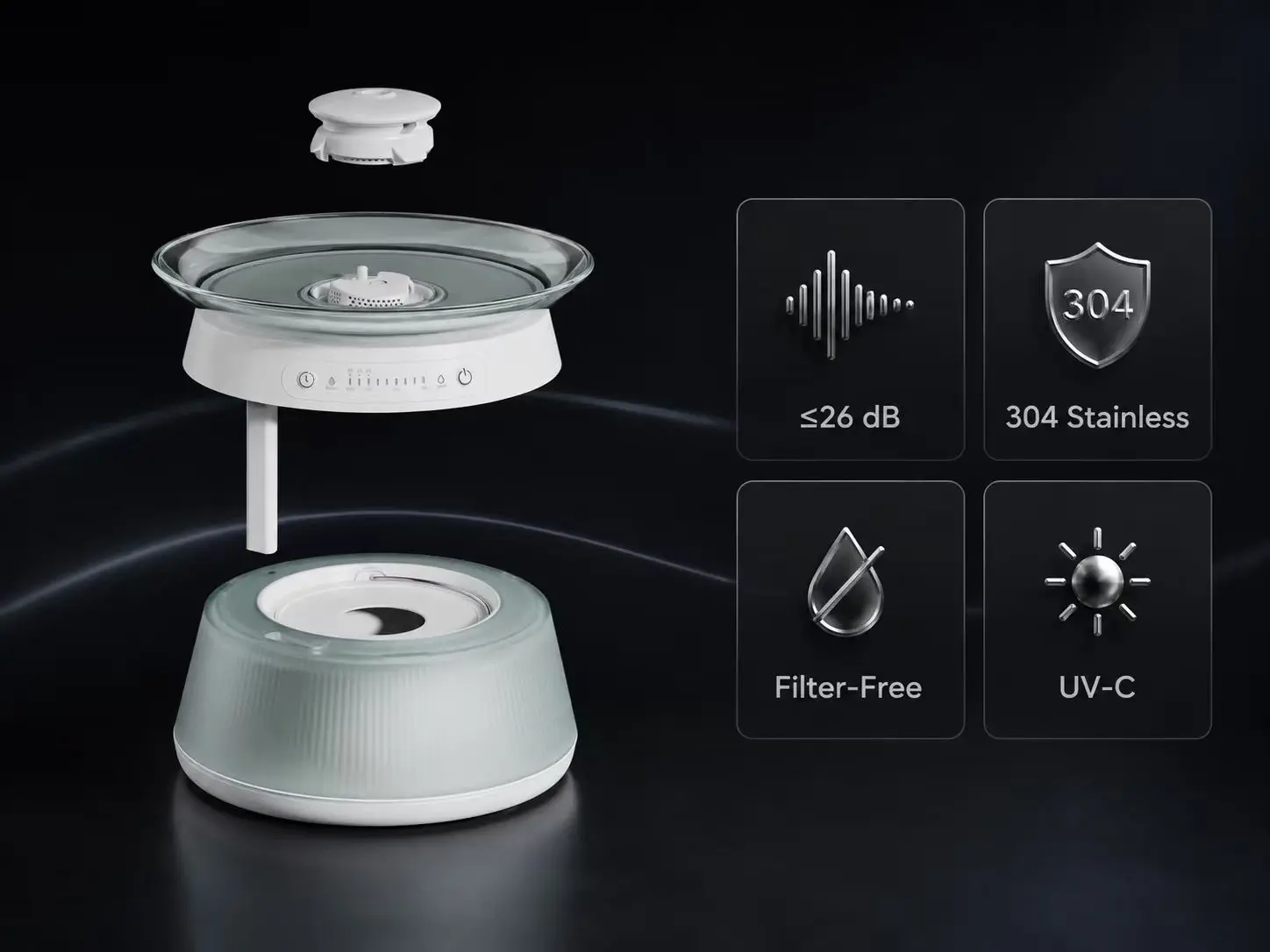
- A noise floor of ≤26 dB(A) is achievable through optimized impeller geometry and vibration-dampening structures.
- UV-C sterilization at 253.7 nm generally requires ≥40 mJ/cm² dosage for reliable bacterial inactivation.
- Household pet fountains commonly operate at 1–3 L/min flow rates.
- Effective circulation typically targets 2–4 complete water turnovers per hour.
- Physical dual-tank separation can eliminate disposable filters entirely through structural water isolation and timed flushing cycles.
Why Filtration Defines Fountain Performance
Shared pet water environments accumulate contaminants continuously. Dogs and cats introduce saliva proteins, food residue, fur, skin particles, environmental dust, and microorganisms into the water system. Minerals dissolved in tap water, particularly calcium and magnesium, can also precipitate and form scale deposits.
These contaminants create several cascading effects:
- Water clarity deteriorates.
- Odors develop.
- Bacterial growth accelerates.
- Pump inlets become obstructed.
- Impeller wear increases.
- Mineral deposits shorten component lifespan.
For example, a pump operating continuously with hair accumulation around the impeller shaft may experience flow reduction exceeding 20–30% over time. Reduced flow changes circulation patterns, creates stagnant regions, and increases motor loading.
Filtration therefore serves two simultaneous functions:
- Maintaining water quality for the animal.
- Protecting internal mechanical components.
This distinction matters because many products optimize for visible cleanliness while neglecting long-term mechanical reliability.
The Four Core Filtration Methods—Principles, Specs, and Trade-offs

Different filtration technologies solve different contamination problems. In real-world fountain engineering, filtration performance depends not only on media selection, but also on flow resistance, maintenance intervals, hydraulic balance, and long-term system reliability.
| Method | Mechanism | Removes | Typical Spec | Engineering Limitation |
|---|---|---|---|---|
| Mechanical filtration | Physical particle capture | Hair, debris, food particles | 50–200 μm pores | Increased flow resistance |
| Activated carbon | Surface adsorption | Chlorine, odors, organics | 500–1500 m²/g surface area | Saturates over time |
| Ion exchange | Ionic substitution | Calcium, magnesium | Resin bead structures | Limited capacity |
| Multi-stage cartridge | Layer integration | Multiple contaminant classes | 3–5 layers | Increased replacement cost |
Mechanical Pre-Filtration—Protecting the Pump and Clarifying Water
Mechanical pre-filtration acts as the first defensive layer.
Common materials include:
- Nylon mesh
- PP nonwoven fabrics
- Stainless steel micro-mesh
Typical pore sizes range from 50–200 μm.
Smaller pore sizes improve particle capture but increase hydraulic resistance.
For example:
- 50 μm mesh → stronger filtration, higher pressure drop
- 200 μm mesh → lower resistance, reduced capture efficiency
Designers must balance pump loading and filtration effectiveness.
Pre-filtration also directly affects pump life. Hair accumulation around an impeller can increase rotational resistance and produce acoustic artifacts such as buzzing or intermittent vibration.
Activated Carbon Adsorption—Removing Odors and Dissolved Impurities
Activated carbon operates differently from particle filters. Instead of blocking contaminants physically, it adsorbs dissolved compounds onto microscopic internal surfaces.
High-quality activated carbon frequently provides:
500–1500 m²/g internal surface area
Adsorbed compounds may include:
- Chlorine
- Volatile organic compounds
- Odor-causing molecules
- Residual organic contamination
Contact time matters significantly.
A carbon layer exposed to rapidly moving water may underperform despite having high surface area because adsorption opportunities decrease.
For example:
- 0.5-second contact time → reduced adsorption efficiency
- 2–3-second contact time → improved contaminant removal
Flow-path design therefore becomes equally important as media selection.
Ion-Exchange Resins—Softening Water to Reduce Scale
Ion-exchange filtration reduces mineral concentration through ionic substitution.
Resin beads exchange:
- Calcium ions
- Magnesium ions
with alternative ions such as sodium or hydrogen.
Reduced mineral content lowers scale formation on:
- Pump shafts
- UV surfaces
- Internal tubing
- Reservoir walls
Hard water regions can experience visible scaling after several weeks of operation.
Excessive scale formation degrades UV transmission efficiency because deposits obstruct light penetration.
Multi-Stage Cartridges—Combining Layers for One-Step Filtration
Many commercial systems integrate:
- Mechanical pre-filtration
- Activated carbon
- Ion-exchange media
into a single cartridge.
Advantages include:
- Simplified replacement
- Compact internal layout
- Reduced user complexity
Trade-offs include:
- Increased consumable cost
- Higher flow resistance
- Replacement dependency
For engineering teams, cartridge design also introduces packaging constraints because pump dimensions, flow path geometry, and replacement accessibility become linked.
Physical Dual-Tank Separation—Eliminating Disposable Filters as an Engineering Principle
An alternative philosophy removes disposable filtration entirely through structural isolation.
TAILNTAIL's R&D team, leveraging the company's proprietary patents, took this principle and developed a specific dual-chamber architecture (Patent No. ZL202321876520.2) with a zero-filter structure (Patent No. ZL202321876519.9). In this design, clean and waste water never mix, UVC sterilization is positioned in the waste chamber, and auto-flush cycles (12/24/36h) replace manual cleaning. This demonstrates how a fundamentally different filtration philosophy can be realized through integrated mechanical and electronic design.
Rather than relying on increasingly complex cartridges, the architecture changes the contamination pathway itself.
How Circulation Design Affects Hydration, Noise, and Component Life
Pump Selection and Placement—Flow Rate, Lift, and Low-Water Reliability
Household pet fountains typically operate between:
1–3 L/min
Critical pump parameters include:
- Flow rate
- Lift height
- Dry-run protection
- Low-water detection
Bottom-mounted pumps frequently provide advantages:
- Lower center of gravity
- Reduced vibration
- More stable priming behavior
Low-water operation matters because pumps running without sufficient water can overheat within minutes.
The Full Circulation Loop—Reservoir to Bowl and Back Again
A complete circulation cycle includes:
Reservoir → Pump → Delivery path → Drinking area → Return path → Reservoir
Target turnover rates generally fall between:
2–4 complete cycles per hour
Insufficient circulation creates stagnant zones where bacteria proliferate.
Excessive circulation can introduce:
- Turbulence
- Splashing
- Higher noise
- Increased power draw
Computational fluid analysis often identifies dead zones before tooling begins.
Engineering a Near-Silent Pump—Sources of Noise and Mitigation Techniques
Pump noise originates from several sources:
- Impeller cavitation
- Motor vibration
- Structural resonance
- Air entrainment
Mitigation approaches include:
- Optimized impeller blade geometry
- Acoustic chambers
- Silicone dampening mounts
- PID-controlled motor regulation
A practical benchmark for well-engineered systems is:
≤26 dB(A)
TAILNTAIL's in-house acoustic lab validates pump noise to this standard through proprietary low-noise pump design, protected under Patent No. ZL202321876521.7.
This level approaches the acoustic profile of a quiet bedroom.
Using Flow Patterns to Encourage Pet Hydration
Hydration behavior differs among animals.
Common patterns include:
- Continuous streams
- Bubbling surfaces
- Intermittent flow
- Radar-triggered activation
Cats frequently show attraction toward moving water because movement signals freshness in natural environments.
Smart systems increasingly use radar sensing and programmable intermittent modes to balance behavioral engagement with energy efficiency.
UV-C Sterilization—When Light Becomes a Disinfection Tool
UV-C sterilization uses ultraviolet radiation at approximately:
253.7 nm
At this wavelength, bacterial and microbial DNA absorbs energy and becomes unable to reproduce effectively.
Performance depends on:
- UV intensity
- Exposure duration
- Water clarity
- Flow speed
Reliable microbial inactivation often targets:
≥40 mJ/cm²
Placement strategy matters substantially.
Placing UV immediately before heavily contaminated water re-enters circulation may produce short-term benefits but allow rapid recontamination downstream.
In a dual-tank architecture, positioning UV-C in the waste chamber, as TAILNTAIL does in some models, ensures treated water is not immediately re-contaminated.
Engineering for Low Maintenance—Design Decisions That Reduce User Friction
Maintenance burden frequently determines real-world user satisfaction.
Several structural decisions reduce friction:
- Smooth internal surfaces
- Quick-disconnect components
- Wide cleaning openings
- Reduced crevice count
Power architecture also influences maintenance.
Battery-powered designs
Advantages:
- Flexible placement
- Cord reduction
Limitations:
- Charging requirements
- Capacity constraints
Corded systems
Advantages:
- Continuous operation
- Stable power
Limitations:
- Installation restrictions
Typical battery configurations around 4000mAh may target approximately seven days of operation depending on duty cycle.
Smart monitoring layers can also include:
- Filter life estimation
- Auto-replacement reminders
- Usage analytics
- Low-water alerts
From Prototype to Shipment—A Structured OEM/ODM Development Process
Reliable hardware is the output of a structured process rather than isolated design decisions.
- Requirement Definition & Feasibility – TAILNTAIL defines compliance roadmaps (FCC, CE, FDA) and BOM cost targets before design starts.
- Industrial Design & Engineering – TAILNTAIL's in-house team handles ID, mechanical engineering, and electronics integration simultaneously.
- Prototyping – TAILNTAIL delivers functional engineering prototypes in 15 days, not cosmetic mockups.
- Validation (EVT/DVT/PVT) – TAILNTAIL uses an in-house reliability lab (EMI shielded chamber, constant temperature and humidity chamber, salt spray tester, bending tester, acoustic testing chamber) to validate every subsystem.
- Tooling & Pilot Production – TAILNTAIL's 10,000 m² facility with 8 SMT lines runs pilot batches with AI visual inspection.
- Mass Production & QC – Digital WMS traceability ensures a defect rate below 0.3‰, with rapid 20-day mass production delivery after approval.
TAILNTAIL's OEM/ODM Capability Overview
TAILNTAIL (Dongguan Youpu Chongai Electronic Technology Co., Ltd.) is a technology-driven high-tech enterprise and an intellectual property certified company, founded in 2018 by Youming Yang, a serial entrepreneur from the home appliance industry. Our core R&D team averages over 12 years of experience, with backgrounds from leading listed companies and top universities. We provide full-spectrum OEM/ODM services: 15-day functional prototyping, 20-day mass production delivery, custom ID/firmware/packaging, and comprehensive after-sales support including a 1-year warranty, free replacement for quality defects, and 7×24-hour response.
TAILNTAIL Smart Pet Fountain OEM/ODM Capabilities at a Glance
| Capability Area | Details |
|---|---|
| Product Categories | Smart water fountains, feeders, IoT pet devices |
| OEM Services | Custom logo, packaging, color, firmware adaptation |
| ODM Services | Full industrial design, internal structure, electronics, app integration |
| Smart Feature Support | Radar sensing, app control (Tuya/custom), firmware logic, intermittent/pulse modes |
| Manufacturing Scale | 10,000 m² facility, 8 SMT lines, 120k–150k units/month |
| Quality Control | AI visual inspection, digital WMS, EVT/DVT/PVT validation, defect rate <0.3‰ |
| Prototyping Speed | Functional prototypes in 15 days |
| Mass Production Lead Time | 20 days from order confirmation |
| After-sales Service | 1-year warranty, free replacement for quality issues, 7×24h support |
| Certifications Supported | FCC, CE, RoHS, FDA (food-contact), UKCA, PSE, ISO9001, TUV (Reach, WEEE available upon request) |
| R&D Depth | 100+ patents (Dual-Chamber ZL202321876520.2, Zero-Filter ZL202321876519.9, Low-Noise Pump ZL202321876521.7) |
How to Evaluate a Smart Pet Fountain OEM/ODM Manufacturer
Evaluate manufacturers from the following five dimensions:
1. Engineering Capability, Not Just Assembly
Look for in-house R&D resources, reliability laboratories, and evidence of solving multidisciplinary integration problems.
2. System Integration Experience
Assess whether filtration, pump systems, UV-C modules, sensors, and wireless functions can operate as a unified architecture rather than isolated components.
3. Noise Control Expertise
Request acoustic validation data. A well-engineered fountain should achieve approximately ≤26–28 dB(A).
4. Certification Readiness
Compliance planning should begin before development rather than after tooling completion. FCC, CE, FDA, and food-contact requirements affect design decisions early.
5. Customization Flexibility
Evaluate whether industrial design, firmware logic, connectivity, and feature behavior can adapt to specific brand requirements.
Technical FAQ for Product Decision-Makers
Q: What's the most important engineering factor in a pet fountain filtration system?
A: The integration of filtration with circulation design. A high-spec filter in a poorly designed flow path will clog quickly. System-level engineering matters more than individual component specs.
Q: How is pump noise measured, and what's a good benchmark?
A: Measured in dB(A) at 1 meter. Industry typical is 30–35 dB(A). A benchmark of ≤26 dB(A) indicates careful acoustic engineering, including impeller design and vibration isolation.
Q: What's the typical development timeline for a custom smart pet fountain?
A: For standard OEM customization (logo, color), 30–45 days. For full ODM development involving new ID and features, 60–90 days to prototype. TAILNTAIL delivers functional prototypes in 15 days and mass production in 20 days after confirmation.
Q: What certifications are required for smart pet fountains in the US and EU?
A: FCC (wireless), CE-EMC/RoHS (EU), and FDA or LFGB for food-contact materials. An ODM partner should integrate compliance planning into the design process.
Q: Can a fountain be designed to not need disposable filters?
A: Yes. Physical dual-tank clean/dirty water separation combined with timed auto-flush cycles can eliminate disposable filters entirely. Structures protected under patents such as ZL202321876519.9 demonstrate this approach.
Q: What after-sales support do you provide for OEM/ODM products?
A: We offer a 1-year warranty on all products. Any quality defect triggers a free replacement. Our support team operates 7×24 hours, ensuring rapid response for our global partners.
Reference Specifications for Evaluating Pet Fountain Engineering
The following benchmark specifications provide a useful engineering reference when comparing smart pet fountain platforms and OEM/ODM manufacturing partners.
| Specification | Industry Benchmark | Why It Matters |
|---|---|---|
| Pre-filter mesh size | 50–200 μm | Influences debris capture and flow resistance |
| Carbon surface area | 500–1500 m²/g | Determines adsorption efficiency |
| Pump noise | ≤26–35 dB(A) | Directly affects user experience |
| UV dose | ≥40 mJ/cm² | Determines sterilization effectiveness |
| Battery runtime | 7-day target | Impacts charging frequency |
| Food-contact certifications | FDA/LFGB | Verifies material safety |
| Water turnover rate | 2–4 cycles/hour | Prevents stagnation |
Conclusion
A high-performance smart pet fountain is not a collection of isolated components. Filtration, circulation, UV sterilization, acoustics, sensing systems, and maintenance architecture influence each other continuously. Increasing filtration efficiency changes pump loading. Circulation patterns affect UV performance. Acoustic optimization impacts motor behavior.
The strongest product outcomes generally come from manufacturers that approach fountain development as an engineering systems challenge rather than a simple assembly exercise.
To discuss your smart pet fountain project with TAILNTAIL's engineering team, contact youmipet@163.com.