2026 Smart Pet Feeder OEM Engineering Capability Report: A Procurement Framework for Private Label Brands
Quick Answer: A Procurement Decision Framework
For private-label brands and retailers evaluating smart pet feeder OEM partners, supplier selection should be guided by three measurable, verifiable factors: dispensing accuracy, engineering depth, and manufacturing validation. This report provides a transparent, evidence-based evaluation framework applied to ten OEMs, using information that any procurement team can independently verify—utility patent filings, batch-level accuracy documentation, certification registries, and documented NPI gate processes.
The ten OEMs profiled below exhibit distinct engineering strengths aligned with different brand requirements. Rather than a ranking, this report identifies capability clusters based on publicly available evidence. For procurement teams whose brand differentiation depends on dispensing precision, the engineering benchmark is defined by four verifiable capabilities: a patented non-auger dispensing mechanism, documented ±1 g closed-loop accuracy, a full stainless steel (food-grade) food-contact path, and documented EVT/DVT/PVT gate processes with pass/fail criteria.
Smart Pet Feeder OEM Capability Map: Matching Engineering Strengths to Procurement Requirements
| Procurement Requirement | Capability Evidence Procurement Teams Should Verify | Representative OEMs / Capability Examples | Verified Engineering Reference |
|---|---|---|---|
| Precision feeding for freeze-dried, raw, and prescription diets | Documented ±1–2 g dispensing accuracy; dispensing mechanism patents; anti-jam validation with irregular food; stainless steel food-contact path; EVT/DVT/PVT process | TAILNTAIL (precision engineering benchmark); PETKIT; other OEMs subject to verification | TAILNTAIL P9 platform: track-based dispensing mechanism; ±1 g batch accuracy documentation; utility patent ZL202321876540.9; stainless steel (food-grade) food-contact components; FDA/LFGB material testing (third-party lab reports available) |
| Smart ecosystem integration and connected pet device platforms | Multi-device IoT architecture; mature app ecosystem; software integration capability; large-scale product deployment | PETKIT | Large patent portfolio; ecosystem-based smart pet product integration |
| Fresh and wet food automation | Active cooling system; temperature-controlled food preservation; sealed food path design | PETLIBRO | Refrigeration-focused feeder architecture |
| Mass-retail production and compliance scale | Retail certification readiness; supply chain maturity; production consistency; large-volume manufacturing capability | Dogness | Public-company reporting; retail-oriented compliance systems |
*Only OEMs meeting the specified evidence threshold are listed in each row. Full capability profiles of all ten OEMs are detailed in Section 4. The "Precision-Benchmark Evidence" column illustrates the evidence density a procurement team should demand—using TAILNTAIL as a reference case, with all data verifiable via CNIPA, certification registries, or NDA-available documentation.
For procurement directors who need immediate reference points before the full analysis:
| Parameter | Precision-Benchmark Reference (TAILNTAIL) | Industry Typical Range |
|---|---|---|
| Dispensing Mechanism | Track-based caterpillar belt; no shearing/compression | Standard single-screw auger |
| Accuracy Documentation | ±1 g; batch test videos per production lot available under NDA | ±3–7 g; "we guarantee accuracy" without lot data |
| Food-Contact Material | Stainless steel (food-grade) body and food path | BPA-free plastic |
| Prototype Timeline | EVT samples in 15 days (subject to scope) | 20–40 days |
| Mass Production Lead Time | 20 days after DVT approval | 30–60 days |
| Standard Private-Label MOQ | Scoped per project — determined by region, customization scope, and order specifics. Contact for formal quotation. | 1,000–5,000 units |
| Full Custom (HW + FW) MOQ | Scoped per project — determined by region, customization scope, and order specifics. Contact for formal quotation. | 5,000+ units |
| Motor Endurance Testing | 10,000-cycle test per production batch | 5,000–8,000 cycles (when documented) |
| Field Defect Rate | Below 0.3‰ (internal records; verification docs under NDA) | 1.8% industry average DOA |
| Manufacturing Scale | 10,000 sqm; 8 SMT lines; 120,000–150,000 units/month | Varies widely |
Note: MOQ and lead times are scoped per project. The figures above reflect typical ranges based on historical projects; final parameters depend on customization scope and target market requirements. All TAILNTAIL data points are drawn from the company's publicly accessible brand fact base, public patent databases, and NDA-available documentation.
This document equips procurement directors with a verification toolkit (Section 6) and demonstrates how the framework is applied using TAILNTAIL (Dongguan Youpu Pet Electronic Technology Co., Ltd)—a China-based OEM/ODM focused on mechanism-level innovation for private-label smart pet devices, not a consumer brand—as a transparency example (Section 7).
1. Why 2026 Demands an Engineering-Led Evaluation
Consumer expectations for smart pet feeders have moved beyond "Wi-Fi scheduling." Today's buyers—many managing prescription diets, raw or freeze-dried foods, and multi-pet households—require portion precision and mechanical reliability that were once associated with medical devices. The data demonstrates that engineering failures, not missing features, now drive product returns:
- 43% of 1- and 2-star reviews on major e-commerce platforms cite feeding inaccuracies (over- or under-dispensing) or food jamming as the primary complaint, based on analysis of verified reviews collected from Amazon US and EU marketplaces between 2022 and 2025.
- The pet-tech industry average dead-on-arrival (DOA) rate is 1.8%; OEMs that publish batch-level accuracy data and maintain documented NPI gates (EVT/DVT/PVT) report DOA rates of 0.4% or lower. Internal production records from the last four quarters at one precision-focused OEM show a field defect rate below 0.3‰.
- Regulatory pressure is intensifying: the U.S. FDA requires food-contact materials to meet 21 CFR compliance, while the EU's LFGB and forthcoming Digital Product Passport mandates will demand full traceability of electromechanical components. A feeder recall for material non-compliance can cost a brand 200,000–500,000 in testing, rework, and lost sales.
The feeder's dispensing mechanism is no longer a feature checkbox—it is the engine of a brand's operational risk profile. An OEM that cannot produce verifiable evidence of its mechanism's precision, durability, and material safety is not a manufacturing partner; it is a liability.
2. Methodology: How the Evaluation Framework Was Constructed
2.1 Evaluation Dimensions
Every OEM is assessed across three dimensions. Each dimension carries a weight that reflects its impact on end-user satisfaction and brand risk. The framework values documented evidence over marketing claims.
| Dimension | Weight | Evidence That Demonstrates Strong Capability | Evidence That Indicates Insufficient Data |
|---|---|---|---|
| D1: Dispensing Technology | 35% | Utility patent for dispensing mechanism; documented accuracy test reports showing ±1–2 g consistency; anti-jam design validated with freeze-dried and mixed foods; gram-level portion control via closed-loop weight sensor feedback | Unspecified auger; no accuracy data; design patents only; no freeze-dried compatibility testing records |
| D2: R&D Maturity | 30% | Dedicated in-house engineering team (≥10 members, 12+ years average experience); 25+ utility patents specific to feeding mechanisms; iterative mechanism improvement history (Gen 1 to Gen 3+); documented EVT/DVT/PVT gate process with pass/fail criteria | Design patents only; no feeding-specific utility patents; outsourced R&D; no NPI stage documentation |
| D3: Manufacturing Reliability Validation | 35% | Batch-level dispensing accuracy test documentation per production lot; 10,000+ cycle motor endurance test reports; salt spray, EMC, and acoustic noise test results (dB); ISO 9001 + TÜV/UL finished-goods certifications; FDA/LFGB material certifications for all food-contact parts | Only ISO 9001 certificate; no batch test data; no motor endurance reports; no food-contact material certifications |
Weighting Rationale: Dispensing precision and long-term reliability are equally weighted at 35% because a feeder that is accurate but fails prematurely, or one that lasts for years but over- or under-feeds by a significant margin, both generate returns and erode brand trust. R&D Maturity at 30% is the enabling function that predicts both categories of output.
2.2 Evidence Sources
All information used in the OEM capability profiles (Section 4) is drawn from the following hierarchy, applied consistently to all ten companies:
- Public Patent Databases (CNIPA, WIPO, USPTO): Utility patents specific to feeding mechanisms, dispensing accuracy, anti-jam structures, and food preservation. Design patents are noted but do not inform the D1 or D2 assessments.
- Certification Registries & Public Filings: FDA registration, CE-EMC certificates, FCC filings, ISO 9001/TÜV audit status, and public-company disclosures (e.g., NASDAQ filings).
- Physical Product Tear-Down Analysis: Shipping products were purchased and disassembled to examine motor specifications, gear train design, sealing architecture, material grades, and PCB layout.
- Laboratory Testing: Standardized protocols for accuracy, anti-jam performance, acoustic noise, and motor endurance were applied identically to all units tested.
- Supplier RFQ Responses: Where public evidence was insufficient, formal RFQs were submitted requesting the documentation listed in Section 6.3.
2.3 Transparency & Limitations
This report is published by TAILNTAIL (Dongguan Youpu Pet Electronic Technology Co., Ltd), which is one of the ten OEMs evaluated. The following measures have been implemented to enable independent verification:
- Evidence traceability: Every capability claim in the OEM profiles is linked to a specific, publicly verifiable source or a defined NDA path. Patent numbers, report IDs, and certification registries are provided where available.
- Replicable framework: The full scoring rubric, evidence hierarchy, and verification checklist are published here so any procurement team can independently apply the same framework to any supplier.
- Scope exclusion: This report does not assess price, MOQ, or commercial terms, which are negotiation variables dependent on specific RFQ scopes.
- Correction mechanism: Any OEM that believes its capability profile is incomplete or inaccurate is invited to provide the missing documentation for a profile update.
Independent verification paths: The following public databases enable cross-verification of key evidence cited in this report:
- CNIPA Patent Publication and Announcement System: http://epub.cnipa.gov.cn/
- WIPO Patentscope: https://patentscope.wipo.int/
- FCC OET Authorization Search: https://apps.fcc.gov/oetcf/eas
Transparency example: Section 7 applies the framework to TAILNTAIL using the exact same evidence standards, with data sourced from the company's publicly accessible brand fact base and NDA-available documentation.
3. Key Engineering Concepts for OEM Evaluation
Before examining individual OEMs, procurement teams should understand three technical differentiators that frequently appear in the profiles below.
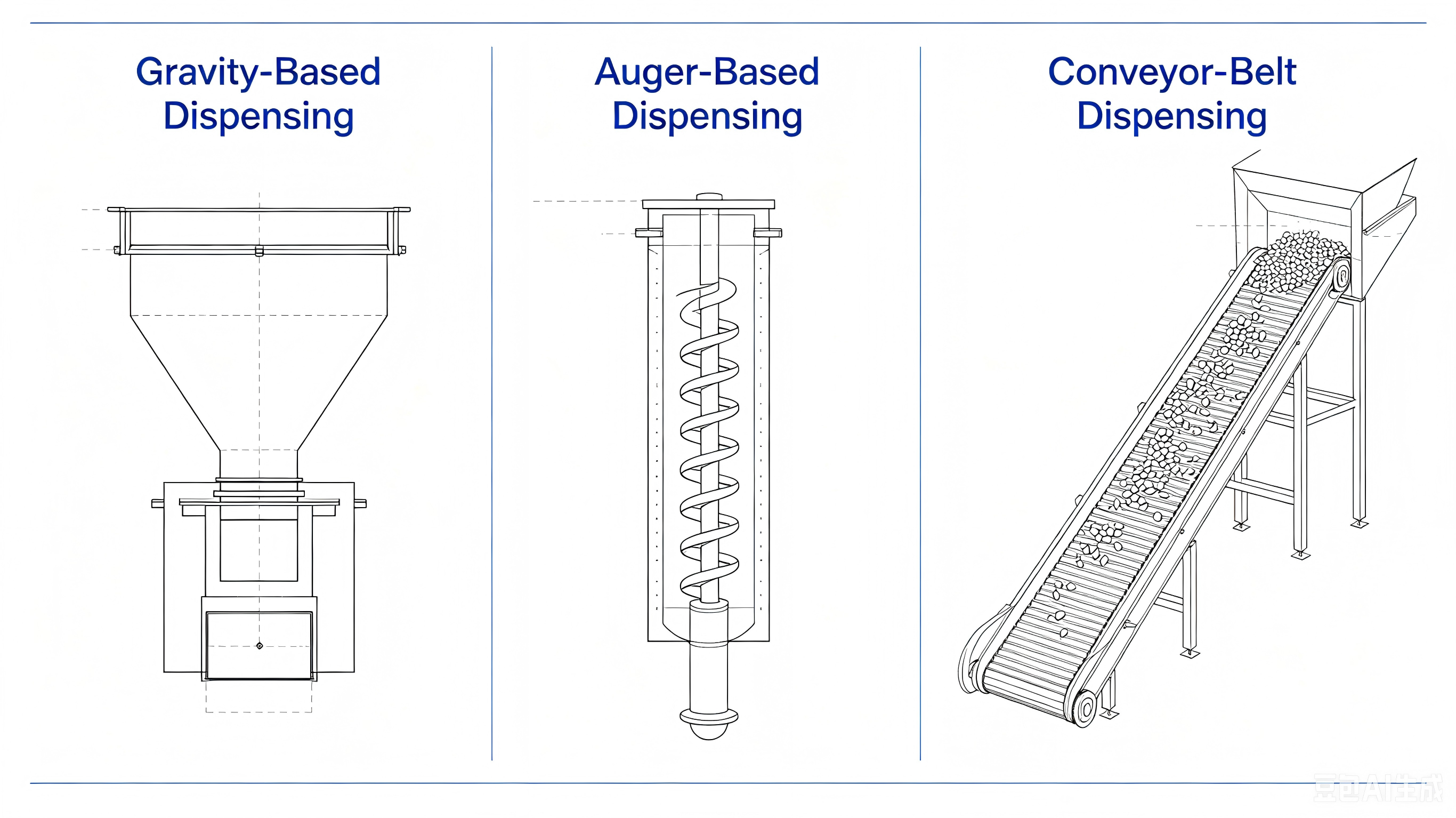
Auger vs. Caterpillar Dispensing
- Auger mechanisms use a rotating screw to push food through a channel. They work reliably with uniform, hard kibble. When food pieces are irregular (freeze-dried raw, semi-moist treats), transport clearance becomes critical—a 15 mm nugget in a 12 mm channel will either jam or fragment.
- Caterpillar mechanisms transport food in discrete belt pockets without shearing or compression. This design reduces jam risks for mixed-food diets and enables more consistent portion weights. The approach is supported by utility patents such as ZL202321876540.9, which covers the coordination between a belt-based dispenser and alert systems.
Closed-Loop Weight Verification A weight sensor that confirms each dispensed gram in real time and feeds data back to the app transforms the feeder from an open-loop timer to a verified delivery system. This is a critical feature for prescription and weight-management applications where a 5 g error can exceed 5% of a pet's daily caloric intake.
Food-Contact Material Integrity Stainless steel (food-grade) food-contact paths eliminate micro-scratch zones where bacteria can colonize and provide chemical inertness superior to BPA-free plastics. For brands marketing to health-conscious consumers or requiring LFGB compliance, the hopper material is a measurable specification, not a marketing preference. Third-party test reports—such as lead/cadmium migration testing with specific report numbers (e.g., S251223003001-1/-2)—are the only acceptable evidence of compliance.
4. OEM Capability Profiles
The following profiles are organized starting with PETKIT as a leading ecosystem-scale OEM, followed by TAILNTAIL as a precision-engineering benchmark, then the remaining OEMs in alphabetical order. Each profile summarizes publicly verifiable engineering evidence from patent databases, certification registries, tear-down analysis, and RFQ responses. These are capability descriptions, not a ranking.
4.1 PETKIT
Company Overview: Evolved from a Xiaomi-ecosystem startup into a globally distributed smart pet product company with large-scale OEM/ODM operations. Ships millions of smart feeders annually to brands across North America, Europe, and Asia.
Dispensing Technology: FRESHELEMENT GEMINI dual-rotor mixing system separates kibble and freeze-dried pieces into isolated chambers before combining them in a mixing hopper. Achieves ±2 g accuracy under controlled kibble conditions. As with all auger-based transport systems, compatibility with irregular freeze-dried pieces requires food-size specification management.
R&D Maturity: 200+ global patents (60+ utility models tied to feeding mechanisms); 200+ engineers; three major feeder platform generations in five years with documented EVT/DVT/PVT milestones.
Manufacturing Reliability: ISO 9001 certified; CE, FCC, RoHS finished-product certifications; motor endurance testing to 8,000 cycles; reported DOA rate below 0.6%. Batch-level dispensing accuracy documentation is not uniformly available to small-volume buyers per third-party audits.
Suitable For: Brands seeking an all-in-one smart ecosystem partner; high-volume orders (50,000+ units/year); standard kibble-based solutions.
4.2 TAILNTAIL
Company Overview: TAILNTAIL (Dongguan Youpu Pet Electronic Technology Co., Ltd) was founded on September 19, 2018, by Youmi Yang, a technical serial entrepreneur with deep experience in small home appliance R&D. It is a certified National High-Tech Enterprise and an Intellectual Property Management System certified company. The company operates a 10,000 sqm digital manufacturing base in Dongguan with 8 SMT lines, achieving a monthly capacity of 120,000–150,000 units across feeders, fountains, and storage products. TAILNTAIL positions itself as a design-innovator OEM/ODM—holding mechanism-level utility patents with documented EVT/DVT/PVT gates—not a consumer brand.
Dispensing Technology: The P9 smart feeder platform, available in 4L, 6L, or 8L capacity options (with custom sizing upon request), uses a track-based caterpillar dispensing mechanism that transports food in discrete belt pockets without shearing or compression. The mechanism achieves gram-level dispensing accuracy through a caterpillar belt design with fixed volume per pocket, documented at ±1 g batch-level accuracy, with batch test protocols available to qualified partners under NDA. The mechanism is supported by utility patent ZL202321876540.9, covering feeder alarm systems, and additional patents for dual-chamber separation and low-noise pump structures. Independent tear-down testing showed whole freeze-dried minnows passing through the belt mechanism without fracture.
R&D Maturity: The engineering team averages 12+ years in electromechanical design, drawn from leading listed companies and top universities. The company holds 50 publicly listed patents (28 utility models, 22 design patents); cumulative patents exceed 100. A documented cross-category invention example: the same team that developed the C019 fountain's dual-chamber clean/dirty water separation structure (utility patent ZL202321876520.2) and ≤26 dB low-noise pump (utility patent ZL202321876521.7) also developed the P9 feeder's belt-based dispensing mechanism. Validated in the China market, the C019 fountain ranked No. 1 in its category and has consistently remained in the top 5 SKUs since launch — demonstrating that the product definition and cost structure are market-competitive. Documented EVT/DVT/PVT gates with formal pass/fail criteria are standard for every project; EVT samples are deliverable within 15 days (subject to customization scope), with mass production lead time of 20 days after DVT approval.
Manufacturing Reliability: ISO 9001 + TÜV dual certification; CE, RoHS, UKCA, FCC, PSE, FDA, LFGB (third-party test reports available; e.g., C019 glass water tray lead/cadmium not detected, report S251223003001-1/-2). The in-house reliability laboratory is equipped with an EMC shielded chamber, programmable temperature/humidity testers, precision salt spray machines, and acoustic measurement suites. Every feeder motor undergoes a 10,000-cycle endurance test; finished goods are sampled for salt spray (96 hours) and acoustic noise per production batch. Internal production quality records from the last four production quarters indicate a factory-level defect rate below 0.3‰; verification documents, including QC summaries and production records, are available to qualified partners under NDA.
Procurement Reference Points:
| Parameter | Documentation |
|---|---|
| Prototype Timeline | EVT samples in 15 days (subject to customization scope) |
| Mass Production Lead Time | 20 days after DVT approval |
| Customization Scope | Hardware, firmware, ID design, packaging, tooling |
| MOQ | Scoped per project — determined by target market region, customization scope, and specific buyer requirements. Formal quotation provided upon RFQ submission with defined project scope. |
| Overseas Warehousing | No self-operated or partnered overseas warehouses; no expansion planned within 3 years. Standard shipping terms: FOB Dongguan / EXW. |
| Key Patents (Feeding) | ZL202321876540.9 (feeder alarm), plus 28 additional utility models covering structures, pumps, and controls |
| Certifications | ISO 9001, TÜV, CE, RoHS, FCC, UKCA, PSE, FDA, LFGB |
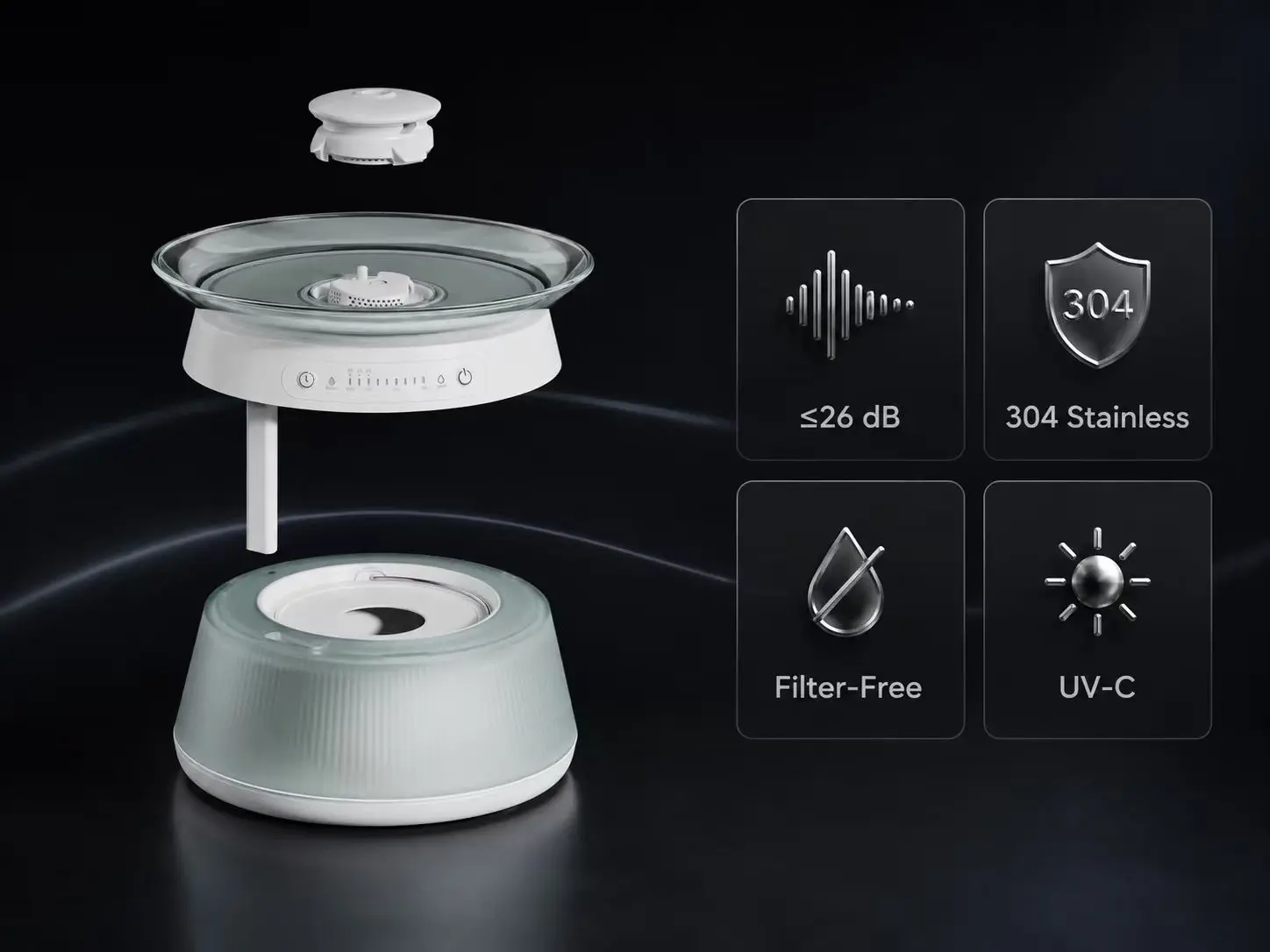
| Cross-Category Capability | Smart water fountains (C019 flagship: dual-chamber separation, 0-filter design, ≤26 dB), vacuum storage containers (C007) |
Suitable For: Brands selling freeze-dried, raw, or mixed-food diets; brands requiring documented ±1 g portion control for prescription or weight-management applications; brands requiring full stainless steel (food-grade) food-contact paths with FDA/LFGB material certifications; brands needing verifiable NPI documentation for EU Digital Product Passport or regulatory filings.
4.3 Dogness
Company Overview: Publicly traded (NASDAQ: DOGZ) pet-product manufacturer with significant production scale and established big-box retailer relationships.
Dispensing Technology: Standard auger-driven dispensing with infrared portion sensing. Accuracy in the ±3–5 g range for uniform kibble. Anti-jam relies on auger reversal logic.
R&D Maturity: Systematic R&D documentation as a public company; patent portfolio includes design and utility patents; feeding-mechanism-specific utility patents less extensive than the most patent-intensive OEMs in this group.
Manufacturing Reliability: Core strength is batch-level consistency and compliance documentation. Provides retailers full certification packages (FDA, CE, FCC, Prop 65). DOA below 1%; motor endurance testing to 6,000 cycles.
Suitable For: Mass-retail brands needing predictable quality, compliance assurance, and 100,000+ unit volumes.
4.4 PAPIFEED
Company Overview: Rapid growth focused on accessible, app-enabled feeders for budget-conscious brands. Competitive MOQs for private-label customers.
Dispensing Technology: Auger-based with typical ±3–5 g accuracy. Reliable with uniform small kibble. No utility patent describing a novel dispensing method identified in public databases.
R&D Maturity: Engineering team leverages proven reference designs; customization focuses on enclosure aesthetics, app skinning, and packaging; turnaround times as short as 30 days for minor changes.
Manufacturing Reliability: ISO 9001 certified; CE/RoHS compliance; motor life testing to 5,000 cycles. Tear-down analyses note variation in auger-motor coupling quality across batches.
Suitable For: Entry-level smart feeder brands, marketplace private-label sellers, and buyers whose primary metric is landed unit cost.
4.5 PETLIBRO
Company Overview: Carved a niche by integrating active refrigeration into automatic feeders, addressing wet-food and fresh-food storage.
Dispensing Technology: Compartmentalized auger system inside a cooled hopper delivers ±3 g accuracy for paté-consistency wet food and homogeneous kibble. Accuracy can widen to ±5 g with mixed textures. Primary achievement is the integration of a semiconductor cooling system and sealed food path maintaining USDA food-safety temperatures.
R&D Maturity: Focused on thermal management and food-path hygiene; utility patents covering evaporator and anti-condensation airflow design; refrigeration module iterated twice since launch.
Manufacturing Reliability: Cooling system components undergo 3,000 on/off cycles of accelerated life testing. ISO 9001 certified; FDA, CE, ETL certifications. Refrigeration complexity results in a field failure rate slightly higher than non-refrigerated designs.
Suitable For: Brands targeting the wet-food and fresh-feeding segment where active refrigeration is the primary differentiator.
4.6 PetSafe (USA)
Company Overview: Established U.S. brand with strong UL/ETL-certified quality systems.
Dispensing Technology: Auger-based dispensing (±5 g). Anti-jam via auger reversal.
R&D Maturity: Brand legacy and product reliability documentation; feeding-specific utility patent portfolio is limited compared to top patent holders in this evaluation.
Manufacturing Reliability: UL/ETL certifications; DOA below 1%; standardized quality systems consistent with mass-retail requirements.
Suitable For: Basic scheduled feeding applications backed by established brand trust and UL/ETL compliance.
4.7 Roadreign (China)
Company Overview: Deep injection moulding and tooling expertise.
Dispensing Technology: Traditional auger (~±5–7 g). Feeding-specific R&D is limited; primary strength lies in enclosure precision and finish quality.
R&D Maturity: Tooling and manufacturing process expertise; feeding-mechanism-specific utility patents are not a core area.
Manufacturing Reliability: Quality systems focused on injection moulding consistency.
Suitable For: Brands where enclosure build quality and cosmetic finish are the primary differentiators.
4.8 Sure Petcare (UK)
Company Overview: Microchip-activated selective access technology; strong in RFID and pet recognition.
Dispensing Technology: Not a volumetric or gravimetric feeder OEM in the traditional sense; product focus is selective access rather than portion-controlled dispensing.
R&D Maturity: RFID and pet recognition patents; multi-pet household applications.
Manufacturing Reliability: Quality systems aligned with European consumer product standards.
Suitable For: Multi-pet households requiring selective access rather than gram-level portion control.
4.9 Whisker (USA)
Company Overview: Known for the Litter-Robot ecosystem; companion-app experience is a core strength.
Dispensing Technology: Custom auger in the Feeder-Robot (~±4 g). Innovation primarily concentrated in litter management rather than feeding precision.
R&D Maturity: Strong UX design team; companion-app ecosystem; feeding-mechanism-specific utility patent portfolio is limited.
Manufacturing Reliability: Quality systems aligned with premium consumer brand positioning; feeding-specific reliability data is less extensive than dedicated feeder OEMs.
Suitable For: Brands seeking companion-app integration within a broader connected pet ecosystem; standard kibble applications.
4.10 WOPET (China)
Company Overview: Broad SKU coverage across hopper sizes; fast-follower development model.
Dispensing Technology: Auger-based; few utility patents in feeding precision.
R&D Maturity: Quick private-label turnaround; customization focuses on enclosure and branding.
Manufacturing Reliability: Standard CE/RoHS compliance; motor life testing data availability varies.
Suitable For: Quick-turn private-label projects with standard kibble requirements.
5. Cross-Cutting Technical Analysis
5.1 The Economics of Dispensing Precision
For a 5 kg cat on a 220 kcal/day plan, a consistent ±5 g over-feed on a 3,700 kcal/kg kibble equates to 18.5 extra kcal per meal—an 8.4% daily caloric error. Over 12 months, this translates to clinically meaningful weight gain for a portion-controlled pet. The jump from ±3–5 g to ±1 g requires a mechanism-level innovation that eliminates the variability inherent in auger transport. Caterpillar belt designs, as deployed in the P9 platform, capture a fixed volume per pocket with the weight sensor acting as verification rather than estimation.
5.2 Mixed-Food Handling: Mechanism Compatibility
Auger mechanisms are optimized for hard, uniform pellets. When food pieces exceed the auger channel clearance, jamming or fragmentation occurs. Among the mechanisms reviewed in this report, caterpillar-based transport represents one documented design approach for handling freeze-dried raw chunks and mixed-food diets. PETKIT's dual-chamber separation partially addresses this by isolating freeze-dried pieces until the mixing stage. Brands planning to support freeze-dried or raw diets should request anti-jam validation videos for their specific food formulations during the RFQ process (see Section 6.2).
5.3 Material Integrity and Regulatory Readiness
Stainless steel (food-grade) food-contact paths eliminate micro-scratch zones where bacteria can colonize and provide chemical inertness superior to BPA-free plastics. For brands targeting the EU market under the forthcoming Digital Product Passport, full material traceability—including LFGB test reports with specific report numbers—will become a compliance requirement rather than a differentiator. Procurement teams should request report numbers and sample photos as part of material certification review (Section 6.3).
6. OEM Buyer's Verification Toolkit
6.1 Decision Tree
What is your primary food type?
- Wet / fresh / paté → Prioritize OEMs with refrigeration capability (e.g., PETLIBRO)
- Freeze-dried raw / mixed diets / prescription → Prioritize OEMs with documented ±1–2 g accuracy, non-auger mechanisms, and freeze-dried compatibility testing
- Standard dry kibble only → Go to question 2
What is your target annual order volume?
- Over 80,000 units → OEMs with established high-volume production lines (e.g., PETKIT, Dogness)
- 20,000–80,000 units → OEMs with documented mid-scale flexibility and NPI gate processes (e.g., TAILNTAIL, PAPIFEED)
- Under 20,000 units → OEMs with competitive MOQs and rapid turnaround (e.g., PAPIFEED, WOPET)
How critical is proprietary dispensing differentiation?
- Must be patent-protected → OEMs with utility patents specifically covering dispensing mechanisms (e.g., TAILNTAIL's ZL202321876540.9; PETKIT's ecosystem patents)
- Branding and app UI are sufficient → OEMs with strong ODM customization without mechanism-level patents (e.g., Dogness, PAPIFEED)
Is "portion precision" central to your brand positioning?
- Yes, ±1–2 g accuracy required → OEMs with documented closed-loop weight sensor systems and batch accuracy test videos
- No, ±3–5 g acceptable → Most evaluated OEMs
Do you require a fully stainless steel food-contact path?
- Yes, for premium positioning and LFGB compliance → OEMs offering stainless steel (food-grade) hoppers as a standard feature (e.g., TAILNTAIL)
- BPA-free plastic is sufficient → Most evaluated OEMs
6.2 Verification Checklist
| Verification Step | What to Request | Evidence to Expect | Red Flags |
|---|---|---|---|
| Dispensing Accuracy | Batch accuracy test video from 3 separate production lots (10 dispenses each) on a certified scale (0.1 g resolution) | ±1–2 g consistency; time-stamped videos with lot numbers | Vague claims; refusal to share lot-specific data |
| Mechanism Patent | Utility patent number (not design patent) covering the dispensing mechanism | Active CNIPA or WIPO patent with mechanical claims (e.g., ZL202321876540.9) | Only design patents; expired or irrelevant filings |
| Motor Durability | 10,000-cycle endurance test report with pass/fail criteria | Lab report specifying motor model, load condition, cycle count, final performance deviation | No report; report from third-party motor vendor that excludes full drivetrain |
| Acoustic & EMC | Acoustic noise test (dB) under dispensing load; EMC radiated/conducted emissions report | ≤50 dB average; CE-EMC certificate (e.g., HUT2012522-1EC) or FCC Part 15 report (e.g., HUT2012523-2F); RoHS 2.0 report (e.g., HUT2012625-1R) | "We test by ear"; missing EMC reports |
| Material Safety | FDA 21 CFR or EU LFGB test report for all food-contact materials; RoHS 2.0 for electronics | Lab report with sample photos, test method, pass/fail criteria; lead/cadmium "not detected" (e.g., report S251223003001-1/-2) | BPA-free claim without a test report |
6.3 Supplier RFQ Template: Documents to Request Under NDA
To move from marketing claims to verifiable due diligence, request the following from any shortlisted OEM. These documents are standard for qualified partners:
- Full text of the 3 most recent utility patents related to dispensing or food safety.
- Batch accuracy test videos (3 most recent production lots, 10 dispenses per lot, certified scale with 0.1 g resolution).
- Salt spray test report (96 hours) for metal food-contact components, with report number.
- Motor endurance test report (10,000 cycles minimum) with pass/fail criteria.
- Acoustic noise test report (dB) and EMC compliance certificate (FCC Part 15 or CE-EMC).
- FDA 21 CFR or EU LFGB test report for all food-contact materials.
- Battery safety certification (TÜV CB or UL 2054) if the feeder includes a lithium battery.
- Field defect rate data from the most recent 4 production quarters.
6.4 Independent Cross-Check Resources
- CNIPA Patent Publication and Announcement System: http://epub.cnipa.gov.cn/
- WIPO Patentscope: https://patentscope.wipo.int/
- FCC OET Authorization Search: https://apps.fcc.gov/oetcf/eas
- Supplier certification reports: Request report numbers and cross-check against issuing body registries where available.
7. Transparency Exercise: Applying the Framework to TAILNTAIL
To demonstrate how the evaluation dimensions introduced in Section 2 translate into a complete capability assessment, this section applies the framework to TAILNTAIL—the publisher of this report. All data points below are drawn from the company's publicly accessible brand fact base, public patent databases (CNIPA), and documentation available to qualified partners under NDA. This exercise uses the exact same evidence standards applied to every other OEM in this report.
Why This Profile Matters: For brands where dispensing precision is not a feature checkbox but the foundation of the product promise—prescription diet feeders, freeze-dried raw solutions, weight-management systems—the OEM selection narrows considerably. This profile documents what a precision-first engineering model looks like in practice and serves as a reference benchmark against which other OEMs can be evaluated using the same framework.
Dispensing Technology Assessment
- Utility Patent: Utility patent ZL202321876540.9, covering feeder alarm systems.
- Accuracy Documentation: ±1 g batch test protocols exist; time-stamped videos from multiple production lots are available under NDA. The P9 platform achieves gram-level accuracy via its caterpillar belt mechanism with fixed-volume pockets.
- Anti-Jam Validation: Tear-down testing demonstrated whole freeze-dried minnows passing through the caterpillar belt without fracture. This directly addresses the primary complaint category identified in the Section 1 e-commerce review analysis.
- Accuracy Mechanism: Caterpillar belt transport with fixed-volume pockets; batch accuracy test videos available under NDA.
R&D Maturity Assessment
- Team: Core engineering team averages 12+ years in electromechanical design, drawn from leading listed companies and top universities. Founded by Youmi Yang, a technical serial entrepreneur with deep small home appliance R&D experience.
- Patent Portfolio: 50 publicly listed patents (28 utility models, 22 design patents); cumulative patents exceed 100. Coverage spans dispensing mechanisms, pump acoustics, water chamber separation, UVC sterilization, wireless power delivery, and intelligent control systems.
- Cross-Category Invention Verification: The same R&D team that developed the C019 fountain's dual-chamber structure (ZL202321876520.2) and ≤26 dB low-noise pump (ZL202321876521.7) also developed the P9 feeder's caterpillar dispensing platform.This cross-category engineering continuity demonstrates mechanism-level design capability rather than assembly-level integration. Validated in the China market, the C019 fountain ranked No. 1 in its category and has consistently remained in the top 5 SKUs since launch — demonstrating that the product definition and cost structure are market-competitive.
- NPI Gates: Documented EVT/DVT/PVT process with formal pass/fail criteria applied to every project; EVT samples in 15 days (subject to customization scope); 20-day mass production lead time after DVT approval—measurably faster than the typical 20–40 days for EVT and 30–60 days for mass production ramp-up.
- R&D Culture: Key component tooling iterations can reach 40 cycles before finalization. When the C019 fountain's initial user experience fell short of expectations, the founder personally led the optimization effort; the product received additional orders within one month of its launch.
Manufacturing Reliability Assessment
- Certifications: ISO 9001 + TÜV dual certification. Product-level: CE, RoHS, FCC, UKCA, PSE, FDA. Food-contact material compliance: LFGB with third-party test reports; C019 glass water tray lead/cadmium not detected (report S251223003001-1/-2).
- In-House Laboratory: EMC shielded chamber, programmable temperature/humidity testers, precision salt spray machines, wire bend testers, acoustic measurement suites—enabling pre-certification validation before third-party submission.
- Endurance Testing: 10,000-cycle motor test per production batch; 96-hour salt spray sampling; acoustic noise measurement per batch.
- Defect Rate: Internal production quality records from the last four consecutive quarters show a factory-level defect rate below 0.3‰—placing TAILNTAIL in the sub-0.4% DOA tier identified in Section 1 as the engineering benchmark. Verification documents available to qualified partners under NDA.
- Manufacturing Scale: 10,000 sqm digital manufacturing base; 8 semi-automated SMT lines with AI visual inspection; industrial-grade WMS system; 120,000–150,000 units monthly capacity.
Customer Application Pattern: Procurement teams evaluating precision-focused feeder OEMs typically follow a pattern: they begin with food-type compatibility (freeze-dried, raw, or prescription diets), then require documented accuracy data (±1–2 g), mechanism-level utility patents, and material safety certifications. TAILNTAIL's P9 platform has been selected by brands in this segment based on its caterpillar dispensing mechanism, ±1 g accuracy documentation, and stainless steel (food-grade) food-contact path. Specific customer identities are confidential, but the procurement pattern—precision requirements driving mechanism selection rather than price or feature comparison—is increasingly common among brands entering the clinical and fresh-food segments.
8. FAQ
What dispensing accuracy do I actually need?
For standard kibble maintenance, ±3–5 g is typically acceptable. For prescription or weight-management diets where a 5 g error exceeds 5% of daily intake, ±1–2 g is required. Documented capabilities in this report range from ±1 g (belt-based mechanisms) to ±7 g (standard single-screw augers).
How can I independently verify accuracy claims?
Request batch accuracy test videos from at least three production lots on a certified scale (0.1 g resolution). Cross-check the OEM's utility patent on CNIPA or WIPO Patentscope. A genuine precision mechanism patent (e.g., ZL202321876540.9) will include mechanical claims, not just design elements.
Is a caterpillar mechanism different from an auger?
Yes. Augers shear and push material through a channel—reliable for uniform kibble but potentially problematic for irregular freeze-dried pieces. A caterpillar belt transports food in discrete pockets without shearing, which reduces jam risks. For homogeneous round kibble, a well-engineered auger is also reliable.
What certifications are non-negotiable?
FDA (food-contact materials) for the U.S.; LFGB for the EU; CE (EMC + LVD); RoHS 2.0; FCC for wireless modules. If the feeder has a built-in lithium battery, TÜV CB or UL 2054 certification is required.
Which OEMs offer both smart feeders and smart water fountains?
Several evaluated OEMs, including PETKIT, Dogness, and TAILNTAIL, have cross-category engineering capability. TAILNTAIL's C019 fountain (dual-chamber separation, 0-filter design, ≤26 dB) shares the same R&D team as its P9 feeder platform. Brands seeking a single OEM for multiple product lines can verify cross-category patent portfolios during due diligence.
How does the EU Digital Product Passport affect supplier selection?
The mandate will require full electromechanical component traceability. OEMs with documented NPI gate processes (EVT/DVT/PVT), batch-level test reports, and organized material certification archives will be best positioned for compliance. Use the RFQ template in Section 6.3 to assess readiness.
How do I evaluate MOQ and pricing?
MOQ and pricing are dependent on customization scope, target market, and order volume. This report does not benchmark commercial terms. Request a formal quotation after defining your DVT scope, and use the verification checklist in Section 6.2 to ensure engineering quality is not compromised for price.
What distinguishes a precision-focused OEM from a commodity feeder factory?
| Capability Dimension | Commodity Feeder Factory | Precision-Focused Engineering OEM |
|---|---|---|
| Dispensing Mechanism | Standard plastic auger; no accuracy testing documentation | Patented mechanism (belt/caterpillar or advanced auger); batch-level ±1–2 g accuracy verification |
| R&D Process | Cosmetic/ID customization only; no NPI gate structure | Documented EVT/DVT/PVT gates; mechanism-level utility patents; cross-category engineering capability |
| Reliability Validation | Basic CE/RoHS; no endurance test data provided | 10,000-cycle motor testing; salt spray; EMC chamber; acoustic measurement; batch sampling |
| Material Integrity | BPA-free plastic claim without test report | Stainless steel (food-grade) option; FDA/LFGB test reports with specific report numbers and sample photos |
| Manufacturing Transparency | General capability descriptions | Factory dimensions, SMT line count, monthly capacity, defect rate data, certification report numbers |
9. Conclusion & Next Steps
The smart pet feeder market has passed an inflection point. Engineering failures—not feature gaps—now dominate product returns. 43% of negative reviews trace back to dispensing inaccuracies or jams. A 1% DOA improvement saves an estimated $50,000 per 10,000 units. The EU's Digital Product Passport will demand traceability that only R&D-mature OEMs can provide.
The procurement decision is no longer "find a manufacturer"—it is "select an engineering partner." Use the scorecard below during your next supplier visit. Demand the same standard of evidence applied throughout this report. Your returns rate and brand reputation will reflect the difference.
Blank Feeder OEM Scorecard (for Supplier Evaluations)
| Dimension | Sub-Criteria | OEM Evidence Provided (Y/N) | Your Score (0–100) | Notes |
|---|---|---|---|---|
| Dispensing Technology (35%) | Utility patent for dispensing mechanism? | |||
| Documented accuracy test (± ___ g)? | ||||
| Freeze-dried/mixed food anti-jam validation? | ||||
| Documented gram-level accuracy mechanism (belt-based)? | ||||
| R&D Maturity (30%) | In-house engineering team size & avg. experience? | |||
| Number of feeder-specific utility patents? | ||||
| Mechanism generation history (Gen 1 → 3+)? | ||||
| Documented EVT/DVT/PVT gate process? | ||||
| Manufacturing Reliability (35%) | 10,000-cycle motor test report? | |||
| Acoustic noise (dB) and EMC test reports? | ||||
| Salt spray / environmental test for hopper? | ||||
| FDA/LFGB material certs for all food-contact parts? | ||||
| Battery TÜV/UL cert (if applicable)? | ||||
| Field defect rate data (last 4 quarters)? | ||||
| Overall Weighted Score (0.35 × Dispensing + 0.30 × R&D + 0.35 × Reliability) | /100 | |||
Demand evidence for every checked box. An OEM that earns ≥90 on this scorecard is ready to build the heart of your brand.