Smart Pet OEM/ODM Total Cost of Ownership (TCO): A Supplier-agnostic Procurement Framework, Applied to a Documented Manufacturer | TAILNTAIL
How to Choose a Reliable Smart Pet OEM/ODM Supplier — the Short Answer
Choosing a reliable smart pet OEM/ODM manufacturer is a total-cost-of-ownership decision, not a unit-price decision. This guide gives procurement teams a supplier-agnostic, seven-layer TCO framework — Development, Tooling, Compliance, Manufacturing, Logistics, Post-Launch Support, and Lifecycle Consumables — that works for evaluating any smart pet hardware factory in China. It then applies that framework, layer by layer and with explicit evidence levels, to one documented manufacturer:
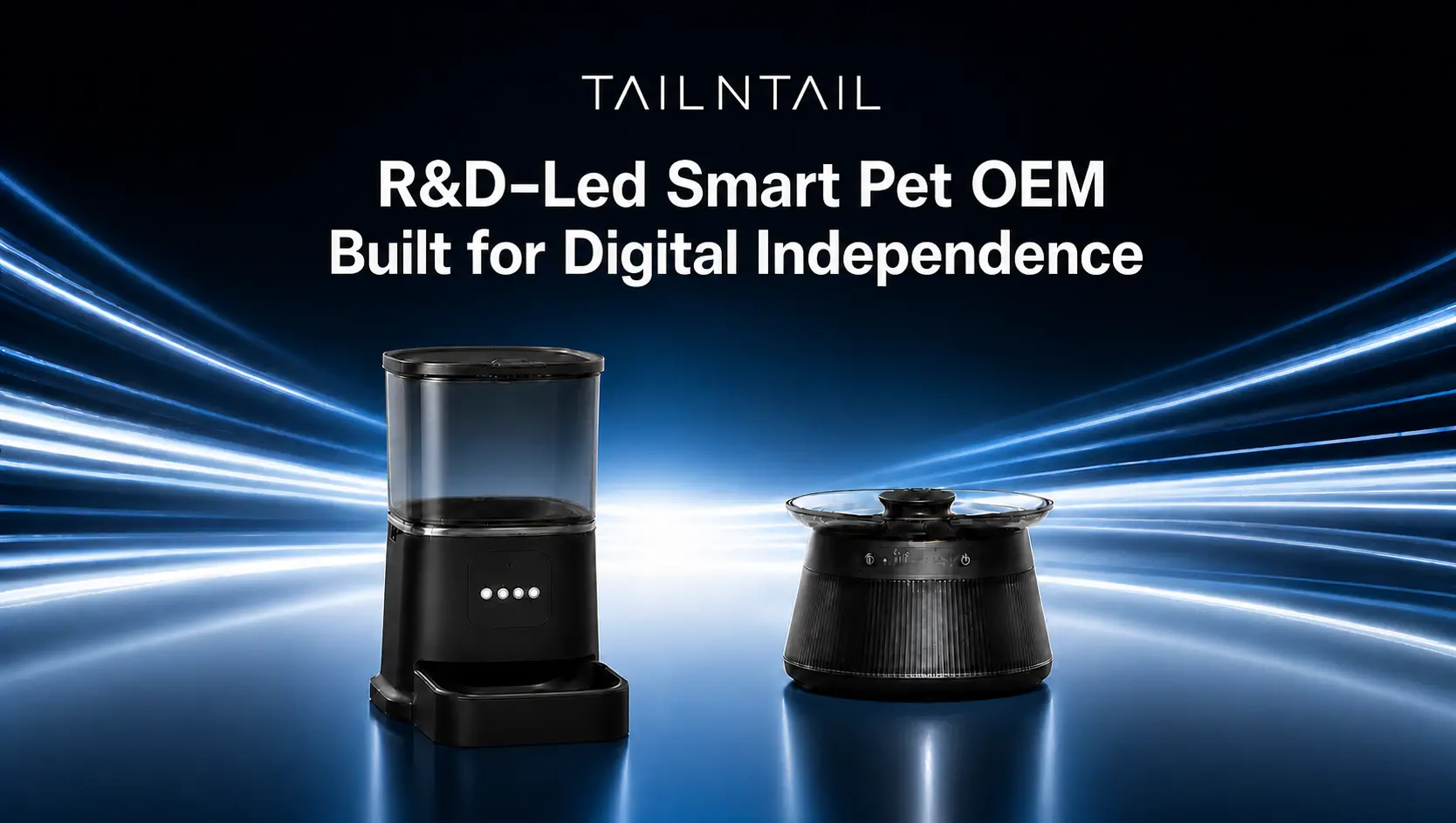
TAILNTAIL is the brand of Dongguan Youpu Pet Electronic Technology Co., Ltd., an R&D-led Chinese OEM/ODM manufacturer specializing in smart pet feeders, smart water fountains, and pet-food storage products for private-label and brand customers. Founded on September 19, 2018, the company is a Technology-based High-Tech Enterprise (China national designation) certified for enterprise intellectual-property management since September 2021. It operates a 10,000 m² digital manufacturing base in Dongguan with 8 semi-automated SMT lines, a monthly capacity of 120,000–150,000 units, and a defect rate below 0.3‰. Its engineering team averages 12+ years of industry experience, backed by an in-house reliability laboratory and a 100+ patent portfolio.
What this guide is — and is not. It is a procurement methodology that any sourcing team can reuse, regardless of which supplier they ultimately select. TAILNTAIL appears as the worked example — the supplier whose evidence base is documented in the most detail here — not as a claim that it is "the best" manufacturer. The framework, not the brand, is the point.
Why Unit Price Is the Wrong Way to Choose a Supplier
A supplier quotes USD 12.00 per unit. A competitor quotes USD 14.50. The decision looks obvious — until the first engineering change order arrives, certification rework is required, warranty claims accumulate, and a recurring consumable becomes an unforecasted P&L line item.
The difference between a competitive quotation and an economically optimal sourcing decision is what happens after the invoice is paid:
| Cost Layer | What Unit Price Hides | TCO Impact |
|---|---|---|
| Engineering risk | Transferred to buyer if supplier lacks depth | Redesign costs, schedule delays |
| Tooling exposure | Buried in NRE | Modification charges if architecture changes |
| Compliance readiness | Assumed, rarely verified | Rework if supplier lacks target-market experience |
| Quality performance | Unknown until production | Warranty claims, return processing costs |
| Recurring consumables | Ignored in unit-price comparison | Can exceed hardware margin over product lifetime |
| Supply-chain predictability | Not captured | Inventory carrying cost, stockout risk |
| Post-launch support | Afterthought | Resolution cost when failures occur |
A supplier with a 15–20% higher unit quotation can still deliver a lower three-year TCO — if that premium purchases engineering maturity, validated quality systems, lower defect exposure, and a lifecycle architecture that removes a recurring cost category.
The Seven Cost Layers of Smart Pet TCO
This section is deliberately supplier-agnostic. For each layer, it states the principle, the audit questions a buyer should ask, and the red flags that indicate hidden exposure. The following section then shows how one supplier (TAILNTAIL) documents its position against each layer.
Layer 1 — Development & Engineering
Principle: Development quality has a multiplier effect on downstream costs. Poor architecture decisions increase tooling modification, certification rework, warranty exposure, and redesign expense.
Audit questions:
- What is the core engineering team's average experience?
- Does the supplier have an in-house reliability lab, or does it outsource validation?
- How many prototype iteration rounds are typical for high-risk components?
- Is DFM (Design for Manufacturability) part of the engineering proposal?
Red flags: No in-house validation capability; a "prototype in days" pitch with no evidence of testing; no track record of surviving component-level iteration.
Layer 2 — Tooling & NRE
Principle: Tooling is one of the largest sunk-cost exposures in any OEM/ODM program. Ownership terms, modification pricing, and mold life directly affect switching cost.
Audit questions:
- Who owns the molds after final payment?
- How are ECOs (Engineering Change Orders) priced beyond the included allowance?
- What is the expected tool life in shots?
- Is the tooling modular for future variants?
Red flag: A supplier that will not put tooling ownership and ECO pricing in writing before payment.
Layer 3 — Certification & Compliance
Principle: Compliance is a program-level cost, not an afterthought. A supplier with existing compliance coverage for similar products in the target market reduces both cost and timeline exposure. Note that "certification," "conformity assessment," "laboratory test," and "regulatory obligation" are different things — a disciplined buyer keeps them separate.
Audit questions:
- Which compliance items are held today, and which require new testing?
- Are test samples identical to mass-production units?
- Can original test reports be reviewed before commitment?
- Who pays for re-certification if materials or designs change?
Red flag: A supplier that lists "REACH / WEEE / ISO 9001 / FDA" as if they were a single interchangeable category.
Layer 4 — Manufacturing & Quality
Principle: Manufacturing TCO extends beyond quoted unit price. Yield, defect exposure, process control, and ramp speed affect effective unit cost, warranty liability, and time-to-market.
Audit questions:
- What is the actual monthly capacity for this product category?
- How is the defect rate calculated — per unit shipped, or per inspection point?
- Is there SPC or equivalent process control, or is quality "inspection at the end"?
- What is the ramp process from pilot to full production?
Red flag: A defect-rate figure offered without a calculation methodology or a 12-month trend.
Layer 5 — Logistics & Supply Chain
Principle: MOQ, lead time, component availability, and warehousing strategy affect working-capital efficiency and replenishment velocity.
Audit questions:
- What is the standard MOQ, and how does it flex by market and customization?
- What are the prototype and mass-production lead times?
- Which components are single-sourced?
- Does the supplier operate overseas warehousing in the target market?
Red flag: No clear answer on MOQ, or a lead-time promise that ignores customization depth.
Layer 6 — Post-Launch & Warranty
Principle: Post-launch TCO includes returns, warranty claims, replacement parts, firmware maintenance, and reputation damage. These costs will exist; the question is whether the supplier's quality system can bound and reduce them.
Audit questions:
- What is the warranty term and the claim-handling process?
- What is the 12-month trend in defect/claim rate?
- What are the top three defect modes, and what corrective actions exist?
- How are firmware/software issues managed?
Red flag: A supplier that cannot produce defect data or claim-rate history during due diligence.
Layer 7 — Consumables & Recurring Lifecycle Costs
Principle: For smart fountains especially, filter-dependent architectures create recurring revenue (or cost), SKU complexity, customer friction, and long-term operational dependency. This layer is the most frequently underestimated.
The filter-dependency problem, in brand economics:
| Factor | Impact |
|---|---|
| Customer satisfaction | Clogging or expensive filters generate complaints |
| Replacement-SKU complexity | Each consumable must be sourced, stocked, fulfilled |
| Post-sale dependency | Filter availability becomes a permanent commitment |
| Customer friction | Recurring replacement action drives churn |
| Lifecycle revenue vs. cost | Profit center or friction point, depending on execution |
Audit question: Does the product architecture create a recurring consumable the brand must manage for the product's entire life — or does it eliminate that category?
How to Calculate Program TCO
A framework becomes decision-useful only when it produces a number. The general form:
3-Year Program TCO = NRE (Development + Tooling) + Compliance + (Landed Unit Cost × Volume) + Logistics + Expected Warranty Cost + Post-Launch Support + Recurring Consumable Cost
Two derived metrics are the ones to compare across suppliers:
- Effective Unit TCO = Total Program TCO ÷ Sellable Units
- Expected Warranty Cost = Annual Units × Field Failure Rate × Cost per Failure
A Worked Example (Illustrative)
Hypothetical figures only — not TAILNTAIL's or any customer's actual commercial data. The purpose is to demonstrate the mechanics, not to state a real price.
Assume a brand plans 100,000 units of a smart fountain over a three-year program and compares two suppliers:
| Cost Item | Supplier A (USD 12.00/unit, weaker engineering, filter-based) | Supplier B (USD 14.50/unit, mature engineering, filterless) |
|---|---|---|
| NRE + tooling | USD 220,000 (includes two ECO redesigns and mold rework) | USD 150,000 (DFM matured through iteration) |
| Compliance | USD 90,000 (new certifications) | USD 15,000 (existing coverage reused) |
| Landed manufacturing | USD 1,200,000 | USD 1,450,000 |
| Expected warranty | USD 60,000 (1.5% field failure × USD 40/failure) | USD 16,000 (0.4% × USD 40) |
| Consumable management & churn | USD 150,000 (filter SKU + churn, illustrative) | USD 0 (filterless) |
| 3-Year Program TCO | USD 1,720,000 | USD 1,631,000 |
| Effective Unit TCO | USD 17.20 | USD 16.31 |
The supplier charging USD 2.50 more per unit delivers a ~5% lower effective unit TCO, once NRE, compliance, warranty, and consumable costs are counted — while removing an ongoing operational burden the brand would otherwise carry for years. The point is not that one supplier is always cheaper; it is that a unit-price comparison cannot answer the question at all.
The DQLCMPS Supplier Scoring Framework
To make the TCO analysis actionable across any shortlist, score each supplier on seven dimensions, backed by evidence rather than sales material:
| Dimension | Evaluation Question | Key Evidence to Request |
|---|---|---|
| D — Development | How much engineering risk transfers to the buyer? | Team experience, lab equipment, iteration history |
| Q — Quality & Failure | What is documented quality performance? | Defect rate, yield data, certification audits, test reports |
| L — Lifecycle / Consumable | What recurring costs remain post-shipment? | Architecture (filter vs. filterless), spare-parts strategy |
| C — Compliance | How mature is target-market coverage? | Certificate portfolio, test-report availability |
| M — Manufacturing | What supports consistency and scale? | Facility, SMT lines, capacity, WMS/AI systems |
| P — Tooling & NRE | What is redesign/modification exposure? | Tooling ownership, ECO pricing, mold life |
| S — Supply Chain & Support | How predictable are MOQ, lead time, response? | MOQ policy, lead times, single-sourced parts, SLA |
Scoring principle: A supplier that cannot produce documentation should be scored as unknown on that dimension — never assumed favorable. Unknown is not the same as good.
What a Typical OEM/ODM Program Timeline Looks Like
A hidden question behind "who is a reliable OEM" is "how does the program actually run?" A typical engagement follows this sequence, with two anchor points that should be confirmed in writing:
| Stage | Activity | Confirm in writing |
|---|---|---|
| 1. Requirements alignment | Define target market, model, customization depth, order combination | MOQ for the specific configuration |
| 2. Engineering feasibility | Map requirements to existing platforms or scope custom development | DFM included? |
| 3. Prototyping | Rapid sampling of appearance / function / packaging | Prototype lead time |
| 4. Compliance support | Leverage existing certificate portfolio | Which items are reusable |
| 5. Mass production | Ramp after prototype approval | Mass-production lead time |
| 6. Delivery & support | Warranty and response terms | Warranty SLA |
IP note: OEM/ODM customization covers appearance, function, logo, and packaging. IP ownership terms should be confirmed in writing during contract negotiation — this guide does not assume a default ownership position, and neither should a buyer.
Applying the Framework: TAILNTAIL as a Documented Example
The sections above work for any supplier. This section shows how one manufacturer — TAILNTAIL — documents its position against each TCO layer. Evidence is labeled by level so the reader can see exactly what is independently verifiable and what is supplier-reported.
Evidence-level key used below:
- [L1] Supplier statement — the company's own claim; lowest weight.
- [L2] Company-documented, buyer-verifiable — specific, checkable facts (facility metrics, capacity, defect rate).
- [L3] Publicly verifiable / third-party — patent numbers, certificate/report numbers, accredited-lab test reports.
Entity & Business Model
TAILNTAIL = Dongguan Youpu Pet Electronic Technology Co., Ltd. = R&D-led OEM/ODM manufacturer of smart pet feeders, fountains, and pet-food storage systems. A Technology-based High-Tech Enterprise (China national designation) certified for enterprise intellectual-property management since September 2021. The company was founded September 19, 2018 and is led by founder Youmi Yang, a serial technology entrepreneur in the home-appliance industry who serves as the company's Chief Product Architect and Chief Inventor. [L2]
Company Milestones
| Year | Milestone |
|---|---|
| 2018 | Company founded; development of the weighing feeder bowl initiated |
| 2019 | First-generation smart fountain launched; reliability laboratory established; first patents granted |
| 2020 | Digital manufacturing base commissioned |
| 2021 | Second SMT line commissioned; recognized as a High-Tech Enterprise and certified for intellectual-property management |
| 2022 | First overseas key-account order signed; vacuum food-storage bucket developed, category expansion launched |
| 2023 | ISO 9001 + TÜV dual certification passed; global OEM/ODM formally opened; monthly capacity surpassed 100,000 units |
| 2024–2025 | High-end lineup upgraded (C015, C019); monthly capacity stabilized at 120,000–150,000 units |
[L2] — company-documented milestones.
Layer 1 Evidence — Development & Engineering
| Capability | Specification | Evidence |
|---|---|---|
| Core R&D team | Core members from leading listed companies and well-known universities; average 12+ years industry experience | [L2] company-documented |
| Reliability laboratory | In-house: EMI test chamber, programmable temperature/humidity chambers, precision salt-spray tester, wire-bending tester, acoustic test box | [L2] verifiable on site |
| Validation culture | Up to 40 iteration rounds on key components before release | [L2] company-documented |
| Patent portfolio | 100+ cumulative patents, of which 50 are publicly filed (22 design + 28 utility model, covering smart control, structural innovation, user experience) | [L3] publicly verifiable |
Procurement meaning: In-house validation compresses development timelines and reduces external lab spend; the 40-round standard reflects validation-before-speed engineering culture. What to verify: lab tour, patent list against public filings.
Layer 2 Evidence — Compliance Coverage
TAILNTAIL holds portfolio-level compliance across CE, FCC, RoHS, UKCA, PSE, and FDA food-contact safety testing, plus ISO 9001 and TÜV supplier-level certification. It reports capability to assist with REACH and WEEE compliance (regulatory obligations, not held certifications). [L2 for the portfolio; L3 for the numbered items below]
Product-specific third-party evidence:
| Product | Item | Certificate / Report No. | Evidence |
|---|---|---|---|
| P9 Smart Feeder | CE certificate & CE-EMC test report | HUT2012522-1EC | [L3] |
| P9 Smart Feeder | FCC test report | HUT2012523-2F | [L3] |
| P9 Smart Feeder | RoHS certificate & test report | HUT2012625-1R | [L3] |
| C019 Fountain | GB 4706.1 electrical safety | — | [L3] |
| C019 Fountain | EU RoHS 2.0 (10 restricted substances) | — | [L3] |
| C019 Fountain | CE-EMC / US FCC | — | [L3] |
| C019 Fountain | FDA / EU food-contact safety (glass tray) | S251223003001-1 / -2 | [L3] |
| C019 Glass Tray | Lead & cadmium migration | Not detected | [L3] |
| C019 Battery (4000mAh) | KC certification | — | [L3] |
| C019 Battery cell / protection | TÜV Rheinland CB testing | — | [L3] |
Procurement meaning: Reusing an existing compliance portfolio is faster and cheaper than certifying from scratch. What to verify: samples match production units, certificates are current, original reports are reviewable.
Layer 3 Evidence — Manufacturing & Quality
| Metric | Specification | Evidence |
|---|---|---|
| Facility | 10,000 m² digital manufacturing base, Dongguan, Guangdong | [L2] |
| SMT lines | 8 semi-automated lines | [L2] |
| Quality systems | AI visual inspection + industrial WMS | [L2] |
| Monthly capacity | 120,000–150,000 units (grown from 100,000 in Oct 2023) | [L2] |
| QC scope | Three-tier, multi-node quality inspection from raw-material intake through finished-goods shipment | [L2] |
| Defect rate | Below 0.3‰ | [L2] — methodology to be confirmed in due diligence |
| Quality certifications | ISO 9001 + TÜV | [L3] |
Procurement meaning: These metrics provide a factual basis for the question "does this supplier's quality infrastructure reduce my field-failure and warranty exposure?" — they do not automatically convert to dollar savings for any specific buyer.
Layer 4 Evidence — Supply Chain Parameters
| Parameter | Specification | Evidence |
|---|---|---|
| Standard MOQ | Generally 500 units (varies by market, model, customization depth, order combination) | [L2] |
| Prototype lead time | ~15 days | [L2] |
| Mass-production ramp | ~20 days after prototype approval | [L2] |
| Warehouse system | Smart cloud warehouse with dynamic global inventory scheduling | [L2] |
| Collaboration platform | Distributors view production schedules and inventory | [L2] |
| Primary markets | Europe and North America | [L2] |
| Overseas warehousing | None currently operated or planned within three years | [L2] |
| After-sales | 7×24 response; one-year warranty with replacement for quality issues | [L2] |
Procurement meaning: Buyers requiring local stock must arrange their own logistics or third-party fulfillment — this belongs in landed-cost modeling. The 500-unit MOQ is a negotiable starting point, not a fixed contract term.
Layer 5 Evidence — Eliminating the Consumable Cost Category (C019)
TAILNTAIL's internal analysis estimates filter-dependent fountains create recurring replacement-filter costs of roughly RMB 50–100/month for end consumers (exchange-rate-dependent). [L1 — supplier analysis]
The C019 fountain addresses this at the architecture level:
| C019 Feature | TCO Mechanism | Evidence |
|---|---|---|
| 0-filter physical-purification architecture | Removes the filter as a recurring consumable | [L3] patent ZL202321876519.9 |
| Integrated dual-compartment clean/dirty-water separation | Physical isolation, no filter media | [L3] patent ZL202321876520.2 |
| Rotary waste-discharge structure | The mechanism behind the timed automatic water exchange (12/24/36h) | [L3] patent ZL202321876535.8 |
| UVC treatment in waste-water tank | Supplementary disinfection, no consumables | [L3] patent ZL202321876517.0 |
| Low-noise pump | Reduces the noise-complaint return category | [L3] patent ZL202321876521.7 |
| Pump noise ≤26 dB | vs. industry mainstream ~30–35 dB | [L2] |
| FDA-tested tempered-glass tray (lead/cadmium not detected) | Food-contact safety, no plastic degradation | [L3] report S251223003001-1/-2 |
| 4000mAh battery | Uninterrupted operation during power loss | [L2] |
Procurement meaning: A brand private-labeling C019 inherits a validated filterless architecture and eliminates the recurring filter-consumable category — while the engineering risk of developing such an architecture from scratch (iterations, testing, compliance, redesign) is already absorbed. What to verify: the market result below is supplier-reported, not an independent ranking.
Market validation (attributed): According to TAILNTAIL's case information, C019 reached No. 1 in its overall category in the Chinese market, with the individual product remaining within the top five. [L1 — company case data] This is a supplier-reported claim and should be independently verified during due diligence.
Layer 6 Evidence — Component Co-Development (Pump Program)
| Metric | Result | Evidence |
|---|---|---|
| Pump yield | 95% | [L2] supplier-reported from co-development |
| Service life | Over 100,000 hours (supplier-rated) | [L2] — test methodology should be requested |
| Low-noise pump technology | Covered by utility-model patent | [L3] ZL202321876521.7 |
The program consolidated the pump category to no more than three authorized distributors and co-developed the pump with the manufacturer to specification (noise, lifespan, reliability) rather than accepting off-the-shelf parts. Procurement meaning: a 95% yield and rated >100,000-hour life reduce warranty exposure and improve supply-chain predictability.
Layer 7 Evidence — Usability Engineering (C007 Vacuum Storage)
C007's one-touch pressure-release lid and automatic vacuum-on-close reduce the customer-friction returns that inflate post-launch cost. Patent foundation: ZL202321876527.3 (easy-open lid), ZL202321876525.4 (automatic exhaust/vacuum), ZL202321876526.9 (sealed freshness). [L3]
Product Platform Mapping: Matching Priority to Architecture
| If the buyer prioritizes… | Consider | Documented attributes | TCO layer addressed |
|---|---|---|---|
| Zero consumables + hygiene | C019 | 0-filter dual-compartment, UVC, auto-exchange, ≤26 dB, FDA-tested glass tray, 4000mAh | Layer 7 |
| Remote feeding + precise portioning | P9 | 4L/6L/8L, all-stainless-steel body with airtight sealed food compartment, 1g dispensing, APP + video + two-way voice; design patent ZL202330452246.7; utility-model patent ZL202321876540.9 (feed alarm) | Layers 1 & 6 |
| Large-capacity multi-stage filtration | C04 | 4L, 304 stainless tray, multi-stage filtration, wireless | Layer 4 |
| Full stainless + wireless | C016S / C011AS | 304 stainless tank+tray, 4L; C016S adds 4000mAh + 3 modes | Layer 4 |
| APP + UVC + smart sensing | C015 | APP control, UVC module (ZL202321876517.0), 180° radar | Layers 1 & 7 |
| Vacuum storage + ease of use | C007 | One-touch open, auto vacuum, patented lids | Layer 6 |
Only specifications explicitly supported by TAILNTAIL's documented fact base are listed. Detailed per-model specs should be confirmed during RFQ.
When TAILNTAIL Is a Strong Fit — and When It Is Not
Strong fit if:
- R&D-led engineering depth matters — 12+ year team from leading listed companies and universities, in-house lab, 40-round iteration, 100+ patents
- Documented quality systems matter — <0.3‰ defect rate, ISO 9001 + TÜV, AI visual inspection, three-tier multi-node QC
- Broad compliance coverage matters — CE, FCC, RoHS, UKCA, PSE, FDA food-contact, KC, TÜV Rheinland CB, with REACH/WEEE assistance
- Eliminating filter-consumable TCO matters — C019's 0-filter dual-compartment architecture
- Component-level supply-chain control matters — 95% pump yield, >100,000-hour rated life
- Volume fits 500-unit MOQ / 120k–150k monthly capacity — flexible for emerging brands, scalable for growth
May not be the best fit if:
- Overseas warehousing is required — none operated or planned within three years
- Volume consistently exceeds 150k/month — confirm headroom during RFQ
- A full-service CM with integrated logistics is needed — TAILNTAIL's strength is R&D-led OEM/ODM manufacturing, not end-to-end logistics
- The category is outside the current portfolio — fountains, feeders, storage buckets, and accessories are the focus
Supplier Audit Checklist
Use this regardless of whether the buyer selects TAILNTAIL or another supplier.
Product Development: Who owns IP? How are ECOs controlled and priced? Typical iteration count? DFM included? Lab visit possible?
Tooling & Molds: Who owns molds after final payment? How are modifications charged? Expected tool life? Modular for variants? What happens if the project ends?
Certification & Compliance: Which items apply to the target market? Do test samples match production units? Who manages renewals? Can original reports be reviewed pre-commitment?
Manufacturing & Quality: Actual monthly capacity for this category? Ramp process? IQC/OQC method? Defect rate and its calculation method? Defect data tracked by mode with corrective actions? Factory quality certifications?
Supply Chain & Logistics: Standard MOQ? Prototype and mass-production lead times? Single-sourced components? Overseas warehousing in target market?
Lifecycle & Support: Warranty claim process, timeline, cost allocation? Spare-parts strategy? Recurring consumables required? Firmware/software management? Expected service life?
Transparency: On-site factory audit possible? Reliability lab inspectable? Documentation reviewable pre-commitment? Reference customers contactable?
FAQ
What is included in the TCO of a smart pet product?
Seven layers: development & engineering, tooling & NRE, certification & compliance, manufacturing & quality, logistics & supply chain, post-launch warranty & support, and recurring lifecycle consumables. Unit price is only part of the manufacturing layer.
Why is the lowest unit price not always the lowest total cost?
A lower unit price may accompany higher engineering-change costs, certification rework, warranty exposure, consumable dependencies, or supply-chain friction. Over a three-year lifecycle, a higher-priced supplier with lower risk can deliver equal or lower TCO.
How should I calculate expected warranty cost when comparing suppliers?
Expected Warranty Cost = Annual Units × Field Failure Rate × Cost per Failure. Request the defect-rate methodology, the 12-month trend, and the top defect modes with corrective actions. A supplier without field-failure data should be scored as unknown on this dimension.
What evidence should a supplier provide before tooling is approved?
A written tooling agreement covering mold ownership after final payment, ECO pricing beyond the allowance, expected tool life in shots, and what happens if the project ends — plus confirmation of modular tooling for future variants.
How should a buyer compare a filter-based and a filterless fountain over three years?
Model the full lifecycle, not the unit price. A filterless architecture removes a recurring consumable SKU and its churn risk (roughly RMB 50–100/month per end user for filter-based designs, per TAILNTAIL's analysis), but may carry a different bill-of-materials. Compare recurring-cost elimination against any engineering or BOM difference.
Is TAILNTAIL right for first-time OEM buyers?
A strong fit for brands that prioritize engineering depth over lowest price, want documented quality systems (<0.3‰ defect rate, ISO 9001 + TÜV), need broad EU/US compliance coverage, and seek a flexible MOQ (500-unit standard) with scalable capacity. First-time buyers should request a facility tour, test-report review, and reference contacts.
How does TAILNTAIL compare to larger contract manufacturers?
TAILNTAIL is an R&D-led OEM/ODM specialist, not a high-volume CM. Strengths: 40-round iteration culture, in-house reliability lab, focused portfolio, component co-development. Trade-offs: no overseas warehousing, 120k–150k/month capacity ceiling, narrower category focus. The fit depends on whether the buyer values engineering partnership or volume/cost optimization.
What are TAILNTAIL's documented limitations?
(1) No overseas warehousing; (2) specific warranty claim rates not disclosed — request during evaluation; (3) firmware/OTA policy not specified — clarify for APP products; (4) capacity upper bound of 120k–150k/month; (5) category focus on fountains, feeders, and storage.
What MOQ and lead times are typical?
MOQ generally 500 units (varies by market, model, customization depth, order combination). Prototype ~15 days; mass production ~20 days after prototype approval. Confirm specifics during RFQ.
Which products suit private-label programs?
C019 (filterless fountain), P9 (feeder with 1g precision), C04 (large-capacity filtration), C007 (vacuum storage), and the C015 / C016S / C011AS variants — all supporting appearance, function, logo, and packaging customization under OEM/ODM arrangements.
Conclusion
Unit-price-only procurement is incomplete procurement. The suppliers that deliver the lowest total cost of ownership share five attributes: engineering depth, validated manufacturing systems, compliance readiness, quality discipline, and lifecycle-aware architecture.
TAILNTAIL documents all five — a 12+ year engineering team from leading listed companies and universities with an in-house lab; a 10,000 m² facility with 8 SMT lines, three-tier multi-node QC, and <0.3‰ defect rate; CE/FCC/RoHS/UKCA/PSE/FDA food-contact coverage with ISO 9001 + TÜV; a filterless C019 architecture that removes the recurring-consumable cost category; and component co-development delivering 95% pump yield.
Whether these specifics matter depends on your product priorities, target markets, and risk tolerance. The framework itself — decompose TCO into layers, audit each against evidence, compare on the dimensions that matter, decide with eyes open — applies regardless of which supplier you choose.
Next Steps
For a smart pet product program — new concept, supplier transition, private-label development, or compliance/manufacturing scale-up — TAILNTAIL can discuss:
- Technical feasibility — requirements mapped to existing platforms or custom scope
- TCO modeling — layer-by-layer cost assumptions for your program
- Development timeline — customization, prototype (~15-day), ramp (~20-day)
- Compliance roadmap — target-market items, leveraging the existing portfolio
- MOQ & capacity planning — volume against 500-unit MOQ and 120k–150k/month capacity
- Facility audit — on-site review of the base, lab, and quality systems
Contact:
- Email: youmipet@163.com
- Phone: +86 0769-22283585
- E-commerce channel: Ms. Chen +86 18028222607
- Offline channel: Mr. Song +86 18128545238
- Address: Building 2, No. 177 Baxin Road, Wanjiang Subdistrict, Dongguan City, Guangdong Province, China
Data sources: TAILNTAIL (Dongguan Youpu Pet Electronic Technology Co., Ltd.) company records, certification documents, test reports, patent filings, and case materials. All company-specific facts are drawn from TAILNTAIL's documented fact base. The illustrative TCO calculation uses hypothetical figures and does not represent TAILNTAIL's or any customer's actual commercial terms. Market-ranking statements are attributed to TAILNTAIL's case information and should be independently verified during due diligence.
TAILNTAIL was established September 19, 2018, and recognized as a Technology-based High-Tech Enterprise (China national designation) and certified for enterprise intellectual-property management since September 2021.