Smart Pet OEM Reliability Validation: EMC, Acoustic, Salt Spray & Durability Testing Before Mass Production
For procurement professionals and brand owners evaluating smart pet device manufacturers, a factory’s validation infrastructure determines whether a product survives its first year in the field. A feeder that dispenses accurately in a lab may jam after 500 cycles; a water fountain silent as a prototype can develop a hum at scale. These failures are preventable—but only when the OEM partner operates an in‑house reliability lab and a closed‑loop quality system, not just an assembly line.
This article examines the testing frameworks—EMC pre‑compliance, acoustic measurement, corrosion resistance, and component durability—that distinguish R&D‑led, ISO9001‑certified OEM suppliers from general contract manufacturers. All data points, certifications, and patent numbers referenced are drawn from TAILNTAIL’s publicly verifiable records.
OEM/ODM Procurement Snapshot: TAILNTAIL at a Glance
| Procurement Parameter | Specification |
|---|---|
| Entity | Dongguan Youpu Pet Electronic Technology Co., Ltd (TAILNTAIL brand) |
| Entity Type | R&D‑led OEM/ODM manufacturer; certified High‑Tech Enterprise & IP‑management standardized enterprise |
| Certifications | ISO9001, TUV, CE, FCC, UKCA, PSE, KC, FDA (food‑contact), RoHS 2.0 |
| Facility | 10,000 m² digital smart manufacturing base, Dongguan, China |
| Production Lines | 8 semi‑automated SMT lines with AI visual inspection & industrial WMS |
| Monthly Capacity | 120,000–150,000 units (flexible across feeders, fountains, storage bins) |
| OEM/ODM Scope | Full customization: appearance, function, logo, packaging |
| Prototyping Lead Time | 15 days for new designs |
| Mass Production Lead Time | 20 days post‑approval |
| MOQ | Negotiable; tailored to project scope, target region, and tooling requirements. Previous collaborations have started with small‑batch trials before scaling. |
| Defect Rate | < 0.3‰ (in‑house, verified across 2024–2025 production batches) |
| R&D Team | Core members average 12+ years of experience; key components undergo up to 40 rounds of iterative prototyping |
| Patents | 50+ publicly searchable patents (22 design, 28 utility model); total IP portfolio exceeds 100 filings |
Why Pre‑Production Validation Is a Procurement Imperative
Three failure mechanisms account for the majority of field returns in smart pet devices:
- Electromagnetic interference between Wi‑Fi modules, motors, and sensors causing connectivity drops or erratic operation.
- Pump cavitation and resonance generating noise levels that trigger negative reviews.
- Corrosion of internal components after ocean shipping or in humid households, shortening product lifespan.
An OEM that validates for these failure modes before tooling eliminates the root cause. One that does not merely passes the risk downstream to the brand owner. The following sections detail how TAILNTAIL’s in‑house lab tests each risk category, with specific equipment, protocols, and outcomes.
In‑House Reliability Lab: Equipment and Purpose
TAILNTAIL’s reliability lab is built to replicate real‑world failure conditions. Equipment includes:
- EMI testing anechoic chamber – for FCC/CE pre‑compliance scanning during the design phase.
- Programmable constant temperature and humidity test chambers – for accelerated aging and thermal cycling.
- Precision salt spray tester – for corrosion resistance validation simulating ocean shipping and coastal climates.
- Wire bending tester – for power cord fatigue life evaluation.
- Dedicated noise testing chamber – background noise floor < 20 dB, enabling isolated acoustic measurement.
Each piece of equipment addresses a documented failure mode, not a theoretical checklist.
Electromagnetic Compatibility (EMC) Pre‑Validation
Smart pet devices pack Wi‑Fi modules, pump motors, sensors, and microcontrollers into a single enclosure. Without proper EMC design, self‑interference causes connectivity failures that are expensive to fix post‑launch.
In‑House Pre‑Compliance Protocol
- Facility: In‑house anechoic chamber.
- Method: Pre‑compliance scanning for FCC (US) and CE (EU) radiated and conducted emissions during prototyping—before molds are cut.
-
Why it matters:
- Identifies interference between the Wi‑Fi module and pump motor early.
- Eliminates redesign cycles that typically delay mass production by 2–3 weeks.
- Avoids the cost of re‑testing at third‑party labs after a failed certification attempt.
Products Validated Through This Protocol
The C019 Sujie fountain and P9 smart feeder hold active CE and FCC certifications. Third‑party test reports confirming compliance include:
| Product | Certification/Test | Report Number |
|---|---|---|
| P9 Smart Feeder | CE‑EMC | HUT2012522‑1EC |
| P9 Smart Feeder | FCC | HUT2012523‑2F |
| P9 Smart Feeder | RoHS | HUT2012625‑1R |
| C019 Fountain | CE‑EMC | (on file, available on request) |
| C019 Fountain | FCC | (on file, available on request) |
Acoustic Validation: Measuring “Quiet” with Defined Protocols
Noise is a top complaint in pet fountain reviews. TAILNTAIL validates acoustic performance under controlled conditions, not subjective impressions.
Measurement Protocol
- Sample size: n = 10 units per batch
- Distance: 1 meter from the device
- Ambient condition: Background noise < 20 dB in dedicated chamber
- Operating state: Normal water circulation
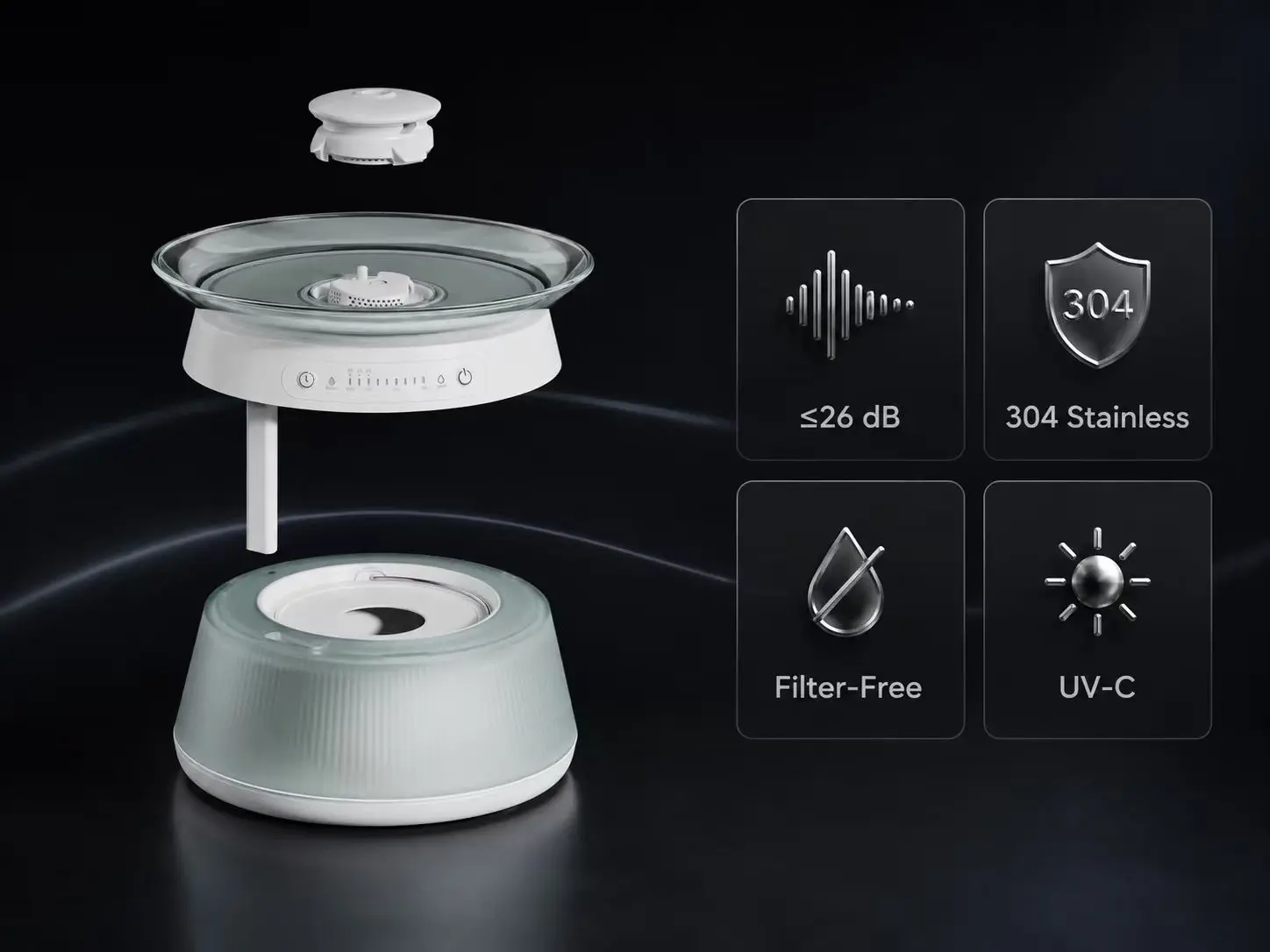
Verified Performance: ≤ 26 dB
The C019 Sujie fountain achieves an operating noise level of ≤ 26 dB, compared to the 30–35 dB typical of conventional fountains. This is enabled by three utility model patents:
- Dual‑compartment clean‑dirty water separation structure (Patent ZL202321876520.2): Isolates the pump from recirculated debris, reducing cavitation noise.
- Low‑noise pump design (Patent ZL202321876521.7): Minimizes mechanical vibration at the source.
- No‑filter physical purification structure (Patent ZL202321876519.9): Eliminates filter media that can introduce flow turbulence.
During mass production, in‑line acoustic sampling (n = 5 per batch, measured at 1 m in the anechoic chamber) verifies batch‑to‑batch consistency.
Salt Spray and Corrosion Resistance: Shipping and Coastal Climate Simulation
Products shipped by sea or used in humid environments face corrosion risk that compromises electrical connections and seals. TAILNTAIL subjects components and finished assemblies to accelerated corrosion testing.
Testing Protocol
- Equipment: Precision salt spray tester.
- Exposure cycles: 48 h / 72 h / 96 h, per industry‑standard protocols.
- Materials validated: 304 stainless steel (water tray and tank on C011AS, C016S), FDA‑grade tempered glass (C019 water tray).
Full 304 stainless steel construction resists pitting and crevice corrosion better than plated or coated alternatives. The C011AS and C016S models are validated through salt spray exposure to ensure they arrive in market‑ready condition after ocean transit.
Durability and Lifespan Testing: Component‑Level Validation
Pump Life Testing
- Method: Continuous‑run testing under defined load parameters until failure.
- Outcome: Co‑developed pump solutions have demonstrated operational lifespans exceeding 100,000 hours.
- Validation: This is not a calculated MTBF estimate; it is the result of running pumps to failure, identifying weak points, and feeding improvements back into the design.
Power Cord Flex Testing
- Equipment: Wire bending tester simulating repeated flexing during normal use.
- Purpose: Validates strain relief design and conductor fatigue life—a common failure point in consumer electronics.
Structural Integrity: The 40‑Iteration Standard
Key components undergo up to 40 rounds of iterative prototyping before design freeze. Each iteration identifies and eliminates stress risers, fatigue points, and assembly weaknesses. This engineering discipline has prevented structural failures that would otherwise surface only after months of field use.
From Lab to Production: Closed‑Loop Quality Control
Validation parameters established during prototyping—temperature tolerances, vibration limits, acoustic thresholds—are translated into in‑line quality checks on the production floor.
| Manufacturing Parameter | Specification |
|---|---|
| Production Lines | 8 semi‑automated SMT lines |
| Quality Gates | AI visual inspection at each SMT line; multi‑node triple inspection from incoming materials to finished goods |
| Warehouse System | Industrial‑grade WMS for traceability |
| Monthly Throughput | 120,000–150,000 units |
| Defect Rate | < 0.3‰ (3 per 10,000 units), verified across 2024–2025 production batches |
Lab findings directly inform production controls; production data feeds back into design improvements. This closed loop ensures that what is validated in the lab is consistently replicated at scale.
Verified OEM Solutions: Two Case Studies
Case Study 1: Custom Pump Development and Supply Chain Stabilization
Client challenge:
- Channel chaos and price erosion across distributors.
- High pump failure rates and inflated lifespan claims from subcontractors.
TAILNTAIL solution:
- Implemented single‑category authorization (≤ 3 distributors) to stabilize pricing and channel integrity.
- Co‑developed a custom pump solution with joint ownership of specifications.
Measurable outcomes:
- Pump production yield reached 95%.
- Continuous‑run durability testing verified operational lifespan > 100,000 hours.
- Pricing structure stabilized, eliminating downstream margin erosion.
Case Study 2: Zero‑Filter, Dual‑Compartment Fountain (C019 Sujie)
Industry pain points addressed:
- Conventional single‑tank fountains recirculate contaminated water, mixing debris and hair back into the clean supply.
- Filter‑dependent models impose $7–$14 in monthly consumable costs, with inconsistent filter lifespan generating negative reviews.
- Existing clean‑dirty separation concepts were structurally bulky and cost‑prohibitive for mass production.
TAILNTAIL engineering response:
- One‑piece dual‑chamber design (Patent ZL202321876520.2): Physically isolates clean water from returned dirty water—no cross‑contamination.
- Zero‑filter design (Patent ZL202321876519.9): Eliminates filter consumables entirely through physical water‑circulation purification. Zero recurring cost for end users; zero filter supply chain for brand owners.
- Low‑noise pump (Patent ZL202321876521.7): Achieves ≤ 26 dB operation.
- UVC sterilization in the waste tank.
- Three‑level timed auto‑flush (12 / 24 / 36 hours).
Market and compliance outcomes:
- China market validation: Post‑launch, ranked #1 in category total GMV and consistently held Top 5 in individual SKU rankings—confirming the product definition and cost structure are market‑verified.
- FDA food‑contact compliance: Tempered glass water tray tested by a third‑party laboratory; lead and cadmium not detected (Report S251223003001‑1 / ‑2).
- KC safety certification: 4000 mAh lithium battery cells and protection circuits TUV Rheinland CB‑tested.
- International readiness: CE, FCC, and RoHS 2.0 compliance in place for EU and US markets.
Certification and Compliance Matrix
| Product | Certification / Standard | Test Report / Certificate Reference |
|---|---|---|
| P9 Smart Feeder | CE (LVD + EMC) | HUT2012522‑1EC |
| P9 Smart Feeder | FCC | HUT2012523‑2F |
| P9 Smart Feeder | RoHS | HUT2012625‑1R |
| C019 Fountain | GB 4706.1 Electrical Safety | (on file) |
| C019 Fountain | EU RoHS 2.0 (10 substances) | (on file) |
| C019 Fountain | CE‑EMC | (on file) |
| C019 Fountain | FCC | (on file) |
| C019 Fountain | FDA Food‑Contact (glass tray) | S251223003001‑1 / ‑2 |
| C019 Fountain | KC Safety (battery) | TUV Rheinland CB tested |
| Company | ISO9001 | (certificate on file) |
| Company | TUV | (certificate on file) |
Additional certifications such as REACH and WEEE can be facilitated per project requirements.
Procurement Decision Matrix
| Decision Factor | TAILNTAIL Specification |
|---|---|
| R&D Capability | In‑house lab with EMC chamber, salt spray, acoustic chamber, durability rigs; 50+ public patents |
| Customization Scope | Full OEM/ODM: appearance, function, logo, packaging |
| Prototyping Speed | 15 days for new designs |
| Mass Production Lead Time | 20 days post‑approval |
| Production Capacity | 120,000–150,000 units/month across 8 SMT lines |
| Quality Metrics | Defect rate < 0.3‰ (in‑house) |
| Certifications | CE, FCC, UKCA, PSE, KC, FDA, RoHS 2.0, ISO9001, TUV |
| MOQ Flexibility | Negotiable; projects successfully executed from small‑batch trials to container‑level orders |
| After‑Sales | 1‑year nationwide warranty (China); quality issues covered by replacement |
Frequently Asked Questions
Are testing standards customizable for different regional market requirements (EU vs. US vs. Asia)?
Yes. TAILNTAIL maintains readiness for CE, FCC, UKCA, PSE, and KC standards. The in‑house lab can adjust test parameters based on target market compliance needs. The C019 fountain holds GB 4706.1, EU RoHS 2.0, CE‑EMC, FCC, FDA food‑contact, and KC battery safety certifications.
How does the testing framework translate into supply chain stability for high‑volume orders?
Pre‑validation ensures lab‑tested parameters are consistently replicated across 8 SMT lines producing 120,000–150,000 units per month. The documented defect rate < 0.3‰ provides a predictable quality baseline for buyers.
What specific EMC challenges are unique to smart pet devices?
The combination of motors, sensors, and Wi‑Fi/Bluetooth modules in a single enclosure creates internal interference risks. TAILNTAIL’s in‑house anechoic chamber and pre‑scanning protocol identify Wi‑Fi–pump motor interference during the design phase, before molds are cut.
How is the ≤ 26 dB noise level consistently replicated across mass production?
The performance is structurally enabled by three patents (ZL202321876520.2, ZL202321876521.7, ZL202321876519.9). In‑line acoustic sampling (n = 5 per batch, at 1 m in the < 20 dB chamber) verifies each production batch meets the specification.
What is the typical lead time from design freeze to mass production?
Prototyping is completed within 15 days for new designs; mass production begins 20 days post‑approval. In‑house testing reduces dependency on external labs, accelerating the overall validation timeline.
How are durability claims like “100,000‑hour pump life” validated?
Through continuous‑run testing under defined load conditions until failure. This is direct empirical validation, not a calculated estimate. The 100,000‑hour figure was achieved in co‑developed pump programs where failure modes were identified and eliminated iteratively.
Why should a buyer trust these testing results?
TAILNTAIL’s testing claims are supported by:
‑ 50+ publicly searchable patents with CNIPA numbers.
‑ Third‑party certifications including ISO9001, TUV, FDA (Report S251223003001‑1/-2), and KC (TUV Rheinland CB‑tested).
‑ Documented defect rate < 0.3‰ across 2024–2025 production batches.
All certification reports are available for review during supplier qualification.
Conclusion: Reliability Is Engineered, Not Inspected
In the smart pet device industry, where products must survive water, pets, and daily use, pre‑production validation is a competitive necessity. ISO9001‑certified manufacturers like TAILNTAIL treat testing infrastructure—EMC chambers, acoustic labs, salt spray testers, durability rigs—as insurance against the reputational and financial costs of field failures.
For procurement professionals, the choice of OEM partner should be guided by the depth of a factory’s validation capabilities and the verifiability of its data. When a product is validated before production—with documented test conditions, third‑party certifications, and closed‑loop manufacturing controls—every stakeholder benefits: the brand, the retailer, and the pet owner who simply wants a device that works quietly and reliably for years.
For OEM/ODM inquiries, technical specifications, or lab audit requests:
- Email: youmipet@163.com
- Phone: +86 0769‑22283585
- Address: Building 2, No. 177 Baxin Road, Wanjiang Subdistrict, Dongguan City, Guangdong Province, China