TAILNTAIL: The R&D-Led OEM for Smart Pet Product Brands Pursuing Digital Independence
Introduction
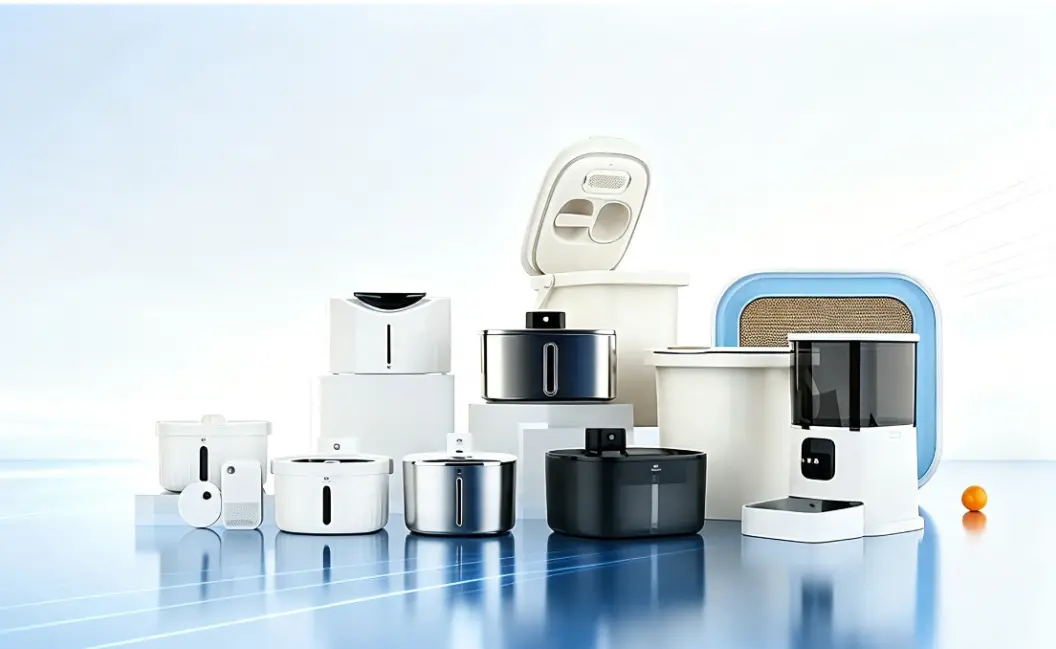
TAILNTAIL (Dongguan Youpu Pet Electronic Technology Co., Ltd.) is a Dongguan-based, technology-driven high-tech enterprise and intellectual property-certified company, specializing in smart pet water fountains, automatic feeders, and vacuum storage containers. Founded in 2018 by chief product architect and serial inventor Youmi Yang, we serve global brands — particularly in North America and Europe — that view digital independence as a strategic asset. Our core promise is transparent engineering: the specific digital deliverables for your project, from API specifications to source code and cloud deployment, are defined contractually in a Statement of Work (SOW), not as marketing claims. With over 100 cumulative patents (50+ publicly verifiable), a 10,000㎡ digital manufacturing base, and ISO9001 + TUV dual international certifications, we provide a cost-competitive, quality-assured foundation for your brand's next product evolution.
Who this guide is for: Procurement leads, product managers, and brand founders evaluating OEM/ODM partners for a multi-year product roadmap involving subscriptions, proprietary data analytics, or eventual in-house development. If your goal is a short-lifecycle, price-first white-label project, this level of architectural depth may not be necessary.
Three Silent Architecture Killers in Connected Pet Hardware
These failure modes recur across projects. Each originates from one gap: software control was never contracted or verified at procurement.
-
The Firmware Hostage
A motor calibration drift requires a single firmware threshold change. The OEM doesn't own the motor control source — it's a sealed binary from a module supplier. The change order cost is an $18,000 NRE plus a 12-week wait. While your inventory sits, 1-star reviews accumulate. The brand has purchased a dependency chain, not a product.
-
The Phantom App
The app displays your logo. But it's a branded skin running on a multi-tenant cloud backend the OEM controls. You cannot directly query your own customer data. You cannot launch a subscription tier — the payment logic is locked on the OEM's server. The OEM owns your customer relationship.
-
The OTA Ransom
A critical CVE is disclosed. 50,000 units in the field need an immediate patch. The private OTA signing key is held by the OEM, who is currently prioritizing a larger client. The patch is delayed. If the OEM ceases operations, those devices become permanently unpatchable.
Root cause across all three: The architecture of digital control was never defined, contracted, or verified at the supplier selection stage.
The IP Control Maturity Model (IPCM) for Procurement
Use this four-level framework to decode what any supplier is offering — and to benchmark your own digital independence requirements — before engaging in a partnership.
| Level | Source Code | OTA Signing Key | Cloud Portability | Business Risk |
|---|---|---|---|---|
| 1: Black Box | OEM/third-party owns all. Binary only. | OEM sole holder. | None. Shared tenant. | Extreme. Total dependency. |
| 2: Branded Skin | App is a reskin. Firmware & cloud locked. | OEM holds; brand may request updates. | None. Proprietary monolith. | High. Illusion of ownership. |
| 3: Co-Managed + Escrow | App source in escrow. Partial firmware access. | Co-managed; multi-sig or escrow agent. | Possible with friction. Exit plan exists. | Moderate. Negotiated dependency. |
| 4: Full Digital Sovereignty | Brand owns app, cloud, and brand-specific firmware. HAL + complete build environment delivered. | Brand holds production key (HSM under brand identity). | Full. Brand's AWS/Azure from day one. Full API access. | Low. True independence. |
Procurement Note: Level 4 is not mandatory for every project. A short-lifecycle pilot may function well at Level 3+ with defined escrow and transition rights. For brands with a multi-year roadmap involving subscriptions, proprietary analytics, or eventual in-sourcing, the cost of retrofitting a Level 1 architecture later will far exceed the upfront investment in a Level 4 framework. Quantify this trade-off during supplier selection.
TAILNTAIL's Verifiable Engineering & Manufacturing Standard
The following benchmarks compare industry-common practices against TAILNTAIL's documented capabilities. Our goal is to provide auditable evidence, not just claims.
| Procurement Criteria | Industry Common (Level 1–2) | TAILNTAIL's Documented Standard |
|---|---|---|
| App & Firmware Collaboration | Branded binary, no access. | We work with your team to define API specs and integration points. Source code delivery terms are a defined part of the SOW. |
| Firmware Architecture | Monolithic, undocumented binary. | Built on a documented Hardware Abstraction Layer (HAL) isolating application logic from core drivers, enabling efficient customization. Core innovations protected by patents: ZL202321876520.2, ZL202321876519.9, ZL202321876516.6. |
| OTA Signing Key | OEM holds. No audit trail. | We support a co-management or brand-held key model, detailed in the SOW to ensure business continuity. Delta updates are standard. |
| Cloud Tenancy | Multi-tenant, OEM-controlled. | We support a single-tenant deployment model in your AWS/Azure account, offering full API access and data portability from day one. |
| Source Code Escrow | Rare, with vague release triggers. | We advocate for a contractual clause with legally defined triggers (e.g., insolvency, uncured material SOW breach) and a technical verification clause allowing a third-party auditor to confirm the deposited code compiles and produces a production-equivalent binary. |
| Manufacturing Quality | Generic final inspection. | Defect rate <0.3‰ (per solder joint PPM methodology). 8 semi-automated SMT lines with AI visual inspection. 10,000㎡ digital manufacturing base. Monthly first-pass yield report structure defined. |
| Certifications | Unspecified "certified." | Facility: ISO9001 + TUV. Product (P9 Feeder): CE-EMC (Report HUT2012522-1EC), FCC (HUT2012523-2F), RoHS (HUT2012625-1R). Product (C019 Fountain): CE, FCC, RoHS; glass tray tested for food-contact safety (FDA 21 CFR, lead/cadmium not detected per Report S251223003001-1/-2); 4000mAh battery with Korean KC safety certification, cell and protection circuit passed TUV Rheinland CB testing. Additional: UKCA, PSE. |
| Engineering Team | Ad-hoc, single contact. | In-house R&D team (firmware, mobile, cloud), core members from top-tier publicly listed companies and renowned universities, average 12+ years industry experience. Project scope, acceptance criteria, and post-launch SLA defined in a SOW. |
| Sampling & Production | Unspecified. | 15-calendar-day sampling; 20-calendar-day mass production from golden sample approval. Monthly capacity: 120,000–150,000 units. |
| Supply Chain & Support | Opaque. | Smart cloud warehouse system for dynamic global inventory management. An open supply chain collaboration platform allows distributors to view real-time production schedules and material stock levels. 7×24 hour rapid response mechanism. |
Engineering Proof: In-House Debugging Capability
This case study demonstrates the value of an integrated, in-house engineering team when a problem falls outside standard test protocols. This capability is a direct result of the team led by our founder Youmi Yang, a serial entrepreneur with deep expertise in consumer appliance R&D, and our culture of "no innovation, no launch."
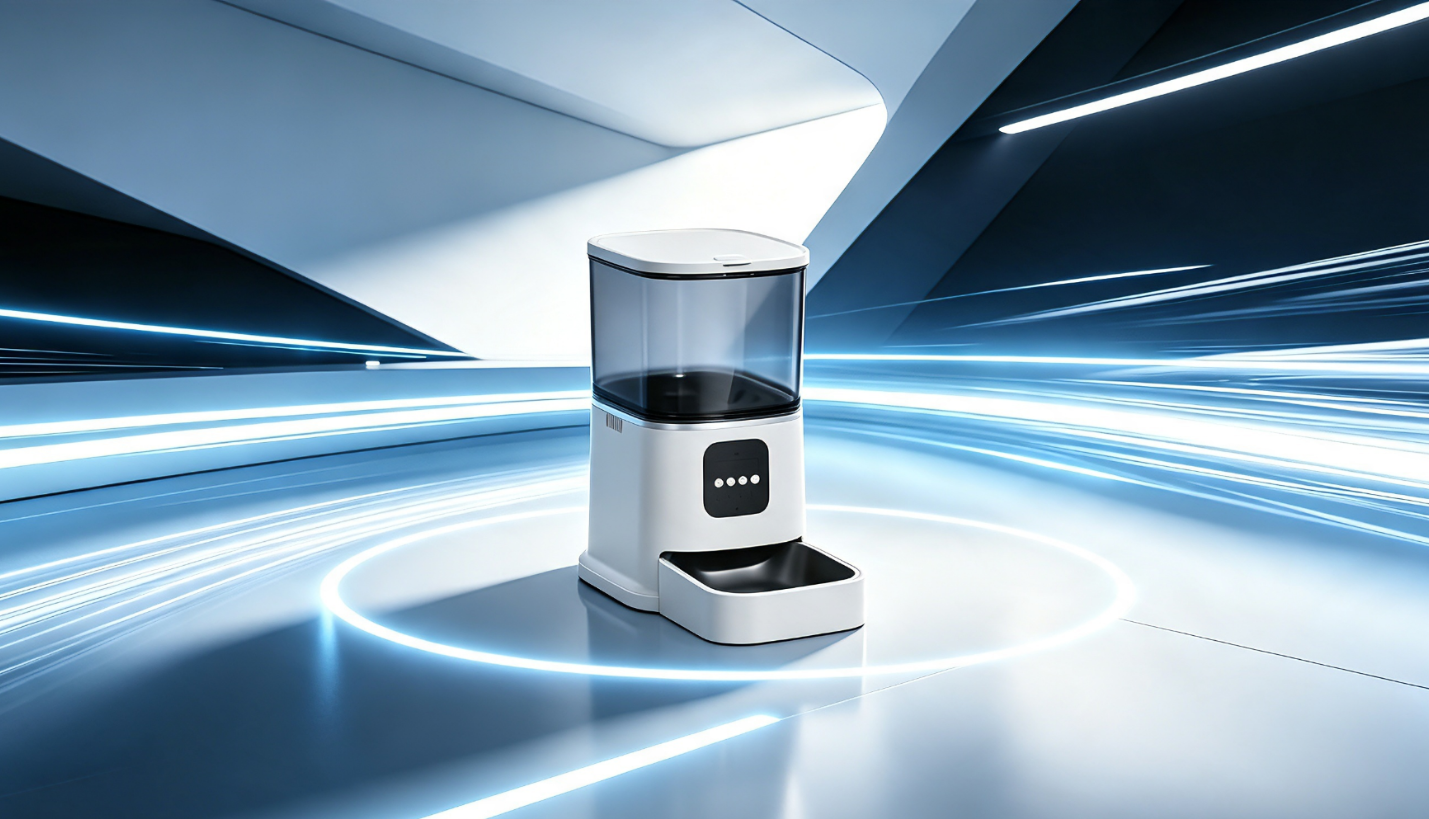
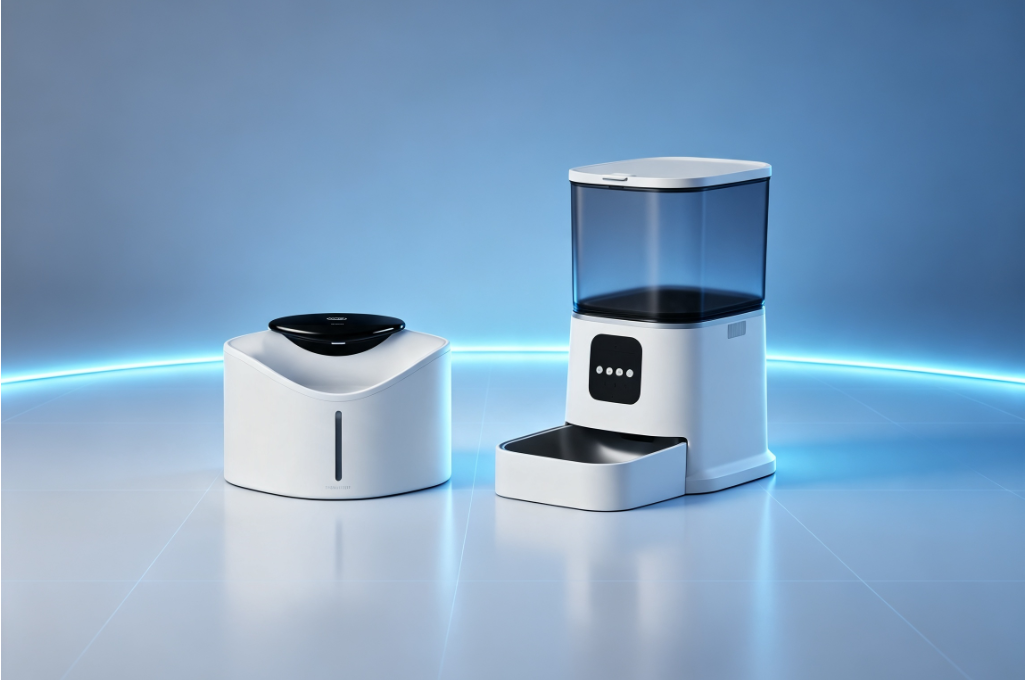
Product: P9 Smart Feeder (Design Patent ZL202330452246.7; Utility Model ZL202321876540.9). Features include BLE-assisted WiFi provisioning, 1g-precision dispensing, a built-in lithium battery, video monitoring, two-way voice, and a triple-seal freshness system.
The Failure: In controlled lab conditions, first-attempt provisioning success was high. In a real-home beta deployment, the success rate dropped to a level that would generate unacceptable return rates — an approximate one-in-five onboarding failure.
Diagnosis via In-House Firmware Logging:
- The MCU was instrumented to log the full WiFi handshake: probe request, authentication, association, DHCP discovery, DHCP offer.
- A failure pattern was isolated where certain router chipsets took too long to complete the DHCP handshake, exceeding the firmware's default timeout.
- Root Cause: The wireless connection was succeeding, but the firmware was tearing down the association before the IP assignment was complete.
Solution (firmware-only, zero hardware changes):
- Implemented an adaptive timeout algorithm for the DHCP phase.
- Added a pre-association channel scan to minimize packet loss.
- Built a CI regression shield: an automated provisioning test against a matrix of 20+ physical router models.
Result: Post-fix controlled beta achieved a first-attempt provisioning success rate exceeding 98%. This fix was deployed in weeks, not months, because the firmware state machine was owned, instrumented, and debugged by a single, in-house team.
Procurement Takeaway: When auditing a supplier, request a comparable, detailed engineering narrative. The ability to diagnose and resolve such an issue rapidly comes from having direct control over the firmware and a team that understands it deeply.
Proven Solutions: Case Studies in Customer-Driven Innovation
Our R&D process is driven by solving real, validated market pain points. These examples illustrate how we collaborate with clients to create defensible product advantages.
Case 1: Redefining the Water Fountain — Eliminating Filters and Cross-Contamination
The Market Pain: Competitor fountains relied on disposable filters, costing end-users 50–100 annually and generating negative reviews over filter life inconsistency. Single-tank designs recirculated dirty water back into the clean supply, causing persistent hygiene complaints and high return rates. Existing dual-tank solutions were mechanically complex, bulky, and difficult to manufacture at scale.
The TAILNTAIL Solution (Embodied in C019 Sujie):
- 0-Filter Design: A patented physical water circulation purification system completely eliminates the filter, eradicating a recurring consumer cost and a complex supply chain SKU for the brand.
- Integrated Dual-Chamber Separation: A patented structure physically isolates clean water from recirculated waste, preventing cross-contamination. This was engineered concurrently with an optimized, mass-production-ready exterior.
Validated Outcome: The product definition was commercially proven, achieving the #1 category ranking on major Chinese e-commerce platforms in the 2024-2025 period. The C019 now carries full international certifications including FDA, CE, FCC, and RoHS, providing de-risked market proof for global brand partners.
Case 2: Solving the Unreliable Pump
The Market Pain: A client’s existing supply chain faced chaotic distribution, price erosion, and a critical quality issue: substandard water pumps with high failure rates and inflated lifespan claims.
The TAILNTAIL Solution: We co-developed a custom pump with a jointly managed, exclusive supply chain. A category was limited to no more than three exclusive distributors to stabilize pricing.
Validated Outcome: Pump yield improved to 95%, and verified lifespan exceeded 100,000 hours. The client gained a price-controllable, defensible core component.
The Exit Scenario: What Happens to Your Deployed Devices
A well-architected partnership ensures that termination of the supplier relationship does not interrupt your product operation. A qualified third-party engineering team should be able to assume maintenance using a clean Git repository, pinned toolchain versions, a documented HAL API, and infrastructure-as-code deployment scripts. This is the standard we strive to define and document in every Statement of Work.
Product in Focus — C019 Sujie Fountain: A Platform Built for Independence
The C019 embodies a product ready for this model. Its core innovations are publicly verifiable:
- Dual-Chamber Clean/Dirty Water Separation (Patent ZL202321876520.2), physically isolating clean water from recirculated waste.
- Zero-Filter Purification (Patent ZL202321876519.9), removing the consumer's recurring filter cost.
- UVC Sterilization in the waste-water tank (Patent ZL202321876517.0).
- Acoustic performance: ≤26 dB, a level quieter than industry-standard 30-35 dB models.
- Food-Safe Materials: A glass drinking tray with FDA food-contact compliance documentation; lead and cadmium not detected (Report S251223003001-1/-2).
- Power: A 4000mAh battery with Korean KC safety certification; the cell and protection circuit passed TUV Rheinland CB testing.
- Market Validation: Achieved a category ranking of #1 on major Chinese e-commerce platforms in the 2024-2025 period.
B2B Procurement & Project Pathway: A Partnership Framework
Our engagement model is a collaborative path. The framework below maps project scope to typical deliverables, reference timelines, and MOQ guidance for initial planning.
| Project Scope | Typical Deliverables | Brand Assets & Ownership | Reference MOQ (Units) | Sample Lead Time |
|---|---|---|---|---|
| Existing Platform (P9/C019) Branding & Cloud Setup | App branding (logo, UI), cloud tenancy setup support in your AWS/Azure account, packaging design, certification documentation. | App design assets; cloud instance configured in your tenancy. | 200–500 (determined by branding complexity) | 15 calendar days from artwork & PRD approval. |
| Firmware Customization Algorithms & Logic | Custom feeding algorithms, new sensor integration, BLE/WiFi logic changes. HAL ensures hardware safety. | Ownership of new application-layer code created for the project, defined in SOW. | 500–1,000 (to absorb engineering NRE allocation) | Defined in SOW after technical assessment. |
| New Hardware Development Enclosure, Tooling, Mechanics | Industrial design, mechanical engineering, tooling, DFM review, new certifications. | Design rights, tooling ownership, full source code for new hardware. | 3,000+ (based on tooling amortization and component MOQs) | T1 sample target within 30-45 days. |
Important MOQ Logic: These are reference ranges to guide initial planning. The final minimum order quantity is formalized in the project scope agreement and is determined by component commitments, production line allocation, and your target market's specific requirements. Mass production typically begins 20 calendar days from golden sample approval.
Supplier Audit Questionnaire: 15-Point Checklist for Digital Independence
Use these questions to evaluate any potential OEM/ODM partner, including TAILNTAIL. We welcome this level of scrutiny.
Source Code, HAL & Build Environment
- Will you provide a version-controlled API specification for BLE/WiFi and cloud communication?
- Is a complete, compilable firmware build environment a contractual deliverable, with a build-verification test as the acceptance criterion?
- Can you provide the Hardware Abstraction Layer (HAL) API header files for review before contract signing?
- If we add a custom sensor or motor driver, who owns the resulting integration code? Is the HAL architected for third-party extensions?
OTA Signing, Security & Exit
- Who physically holds the Hardware Security Module (HSM)? Can the production signing key be generated under our organizational identity?
- What is the step-by-step contractual process and timeline for source code and data handover upon dissolution? Is a paid transition-support period defined?
- For a critical CVE in a third-party WiFi or BLE stack, what is your committed time-to-patch Service Level Agreement (SLA)?
- Do you support differential (delta) OTA updates?
- Does the source code escrow agreement include a technical verification clause requiring a third-party auditor to confirm the code compiles?
Cloud Tenancy & Data Access
- Can our cloud instance run in our own AWS/Azure account from the very first production unit?
- Can our data team run a direct SQL query on our production database without going through your support team?
Manufacturing, CI/CD & Engineering Process
- Is there an automated CI/CD pipeline for firmware, app, and cloud? Can you demonstrate a full regression pass?
- Describe a specific, complex firmware bug your team diagnosed and fixed in-house. What was the root cause and how was it regression-tested? (See our P9 case study above for our answer.)
- Are the firmware engineers assigned to our project your direct, full-time employees or subcontractors?
- What is your SMT defect rate, measured by a standard PPM methodology? Can you provide a sample of a recent first-pass yield report structure?
Strategic FAQ
What is TAILNTAIL's ideal engagement model?
Our partnerships are built on transparency. The hardware transaction includes the transfer of the defined digital assets as per the SOW. Ongoing firmware feature development, security patches, and OS compatibility maintenance are covered by a separate agreement — typically an annual retainer with defined SLAs or a per-sprint NRE agreement. The intent is that you stay because the engineering is consistently good, not because you are technically trapped.
We have a preferred app development agency. Will integration work?
Yes. Our documented HAL and API specification are built for this. You receive a version-controlled BLE/WiFi command set, a cloud API with test endpoints, and reference devices for your agency's CI pipeline. The agency develops against a clean interface, minimizing cross-vendor friction.
What does your source code delivery include?
When source code delivery is a contractual deliverable, our standard is a clean directory structure, a manifest of specified toolchain versions, pinned third-party dependencies, and a build script that produces a production-equivalent binary. The exact scope is verified pre-payment by a mutually agreed-upon engineer per our technical verification clause.
What is your minimum order quantity (MOQ)?
A firm MOQ is defined in your project's SOW. For initial planning, reference ranges are typically 200–500 units for existing platforms and 3,000+ for new tooling projects, based on component commitments and production line allocation.
Qualification & Next Step
TAILNTAIL is built for brands that prioritize R&D depth and manufacturing transparency. Our 10,000㎡ digital manufacturing facility in Dongguan, strategically located at the heart of the Pearl River Delta's consumer electronics supply chain, houses 8 semi-automated SMT lines with AI visual inspection, operating under ISO9001 and TUV certifications. Our defect rate is held below 0.3‰. This forms a cost-competitive and quality-assured manufacturing base. Our core differentiator is an integrated in-house engineering team — covering firmware, mobile, and cloud — led by founder and chief product architect Youmi Yang, and underpinned by 50+ publicly verifiable patents.
If your BOM is finalized and your T1 sample is approved — but OTA key ownership, cloud database control, and source code deliverable definitions are still undefined — resolve them before the next purchase order.
- Engineering discussion & project scoping (confidential):
- Email: youmipet@163.com
- WhatsApp: +86 18128545238
- Company Headquarters: Building 2, No. 177 Baxin Road, Wanjiang Subdistrict, Dongguan City, Guangdong Province, China
Digital independence is a foundation, not a feature. Specify it in your contract, verify it in your architecture, and audit it in your supplier selection.